
Why Your Balance Feels Off - And What You Can Do About It
You wake up dizzy. The room spins. You grab the wall just to walk to the bathroom. It’s not just old age - it’s your vestibular system failing to send the right signals to your brain. This isn’t rare. In fact, 30% of adults over 65 fall at least once a year, and dizziness is one of the top reasons why. But here’s the good news: you don’t have to live like this. Vestibular rehabilitation therapy (VRT) isn’t magic. It’s science - and it works.
What Exactly Is Vestibular Rehabilitation?
Vestibular rehabilitation is a type of physical therapy designed to retrain your brain to recognize and process signals from your inner ear. When your vestibular system gets damaged - from an infection, injury, or just aging - your brain gets confused. It doesn’t know if you’re moving or if the world is. That’s when you feel dizzy, off-balance, or nauseous. VRT doesn’t fix your inner ear. It teaches your brain to compensate. Think of it like relearning how to ride a bike after years of not riding. Your muscles remember, but your brain needs a refresher.
This isn’t new. Physical therapists started using these techniques in the 1980s, and since then, studies have shown it helps people regain control. A major 2012 study found that after VRT, patients improved their balance by 73% and their gaze stability by 68%. That means you can look at your phone while walking without the world blurring. You can turn your head without feeling like you’re going to pass out.
The Four Goals of Vestibular Therapy
Every VRT program is built around four clear goals:
- Improve gaze stability - so your eyes stay locked on a target even when your head moves.
- Improve postural stability - so you don’t wobble when standing still or walking on uneven ground.
- Reduce vertigo - the spinning sensation that makes you feel like you’re on a carousel.
- Restore daily function - so you can cook, shop, walk the dog, or get out of bed without fear.
These aren’t vague promises. They’re measurable. Patients report 37% fewer headaches and 42% less nausea after consistent therapy. One Reddit user went from falling 3-4 times a week to zero after 12 weeks. Another could finally read while walking - something they hadn’t been able to do in years because their vision bounced around.
What Do the Exercises Actually Look Like?
VRT isn’t about lifting weights or running on a treadmill. It’s about controlled movement - the kind that makes you dizzy on purpose. That’s right. You have to provoke the dizziness to fix it.
Here’s what a typical session includes:
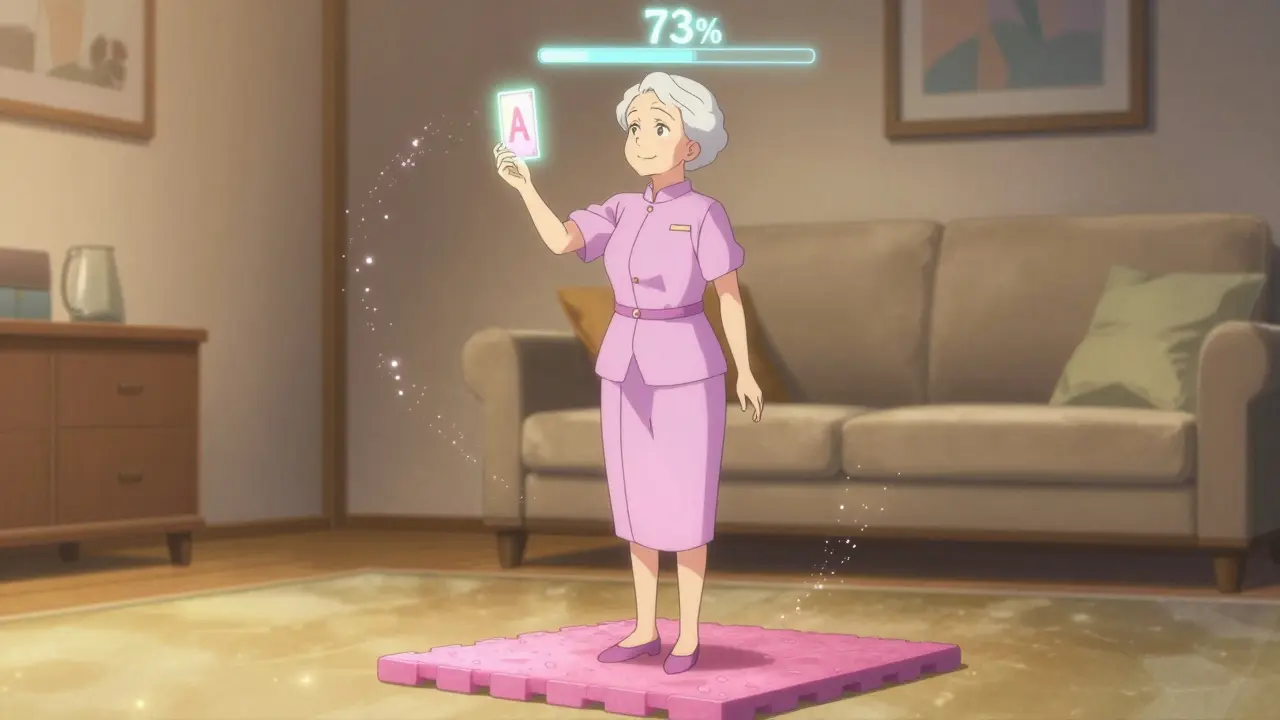
- Gaze stabilization - Sit or stand still. Hold a card with a letter or number about 12 inches from your nose. Move your head side to side or up and down while keeping your eyes locked on the letter. Do this for 30 seconds, 3-5 times a day.
- Balance retraining - Stand on one foot near a wall for support. Once you can do that for 30 seconds, try it with your eyes closed. Then try it on a foam cushion. Progress slowly.
- Habituation exercises - Do movements that trigger dizziness - like turning quickly, bending over, or walking through a busy store - but do them slowly and repeatedly. The goal isn’t to avoid the feeling. It’s to teach your brain to ignore it.
- Walking with head turns - Walk forward while turning your head left and right. Start slow. Add speed as you get better. This trains your brain to coordinate movement and vision.
- Neck mobility and stretching - Tight neck muscles can make dizziness worse. Gentle stretches help reduce tension that pulls on inner ear nerves.
You don’t need fancy equipment. A chair, a wall, and a mirror are enough. Some clinics use virtual reality now to simulate real-world environments - like walking on a moving sidewalk or navigating a dark room - but the basics still work.

Who Benefits the Most?
VRT works for almost anyone with a vestibular issue - no matter their age or how long they’ve been suffering. It’s been proven effective for:
- Benign Paroxysmal Positional Vertigo (BPPV) - the most common cause of dizziness, affecting about 2.4% of people. It’s caused by tiny crystals in your inner ear moving where they shouldn’t.
- Vestibular neuritis - inflammation of the balance nerve, often after a virus.
- Meniere’s Disease - a chronic condition with episodes of vertigo, hearing loss, and ringing in the ears.
- Post-concussion dizziness - balance problems after a head injury.
- Age-related balance decline - even if no specific cause is found, VRT helps older adults stay steady on their feet.
One patient, Rhonda from Texas, used to avoid leaving the house because she got dizzy just walking to the mailbox. After eight weeks of VRT, she started walking her dog again. She didn’t just get better - she got her life back.
How Long Until You See Results?
Most people start noticing changes within 2-4 weeks. Full recovery usually takes 6-8 weeks of consistent practice. But here’s the catch: you have to do the exercises every day. Not once a week. Not when you feel like it.
Therapists recommend doing the exercises 3-5 times a day, for just 5-10 minutes each time. Short bursts. Frequent repetition. That’s how neuroplasticity works - your brain rewires itself through repetition, not marathon sessions.
And yes, you’ll feel dizzy at first. That’s normal. The goal isn’t to avoid it. It’s to let your brain learn that the dizziness isn’t dangerous. One therapist puts it this way: “Every time you purposefully make yourself dizzy, you’re telling your brain, ‘This isn’t a threat.’”
Why Most People Give Up - And How to Stick With It
The biggest reason VRT fails isn’t because it doesn’t work. It’s because people stop. They get discouraged. They think, “I did the exercises for a week and I’m still dizzy.” But that’s like saying, “I did one push-up and my arms aren’t stronger.”
Here’s how to stay on track:
- Link exercises to daily habits - Do gaze stabilization while brushing your teeth. Do balance drills while waiting for your coffee to brew.
- Track progress - Write down how many times you fell last week. Then write it again next week. You’ll see the drop.
- Don’t rush - Progress isn’t linear. Some days are better than others. That’s okay.
- Find a buddy - Do the exercises with a partner. It makes it less lonely.
One study found that 89% of patients regained the ability to do daily activities they’d avoided - like climbing stairs, driving, or shopping - within two months. That’s not luck. That’s consistency.

When to See a Professional
You can start with simple exercises at home. But if your dizziness is severe, comes with hearing loss, ringing in the ears, or numbness, you need to see a specialist. A vestibular therapist can assess your specific issue and tailor a plan. Most hospitals and rehab centers now offer VRT programs - including Texas Health Resources, Penn Medicine, and Princeton Sports and Family Medicine.
Insurance often covers it. You don’t need a referral in every state, but it helps. Don’t wait for a fall to happen. If you’ve been avoiding stairs, feeling unsteady in the dark, or holding onto walls just to walk, it’s time to act.
Preventing Falls Isn’t Just About Strength - It’s About Your Brain
Most people think fall prevention means leg lifts and core workouts. But if your brain doesn’t know where your body is in space, no amount of squats will help. VRT fixes the root problem: your brain’s ability to interpret balance signals.
And the stakes are high. Falls are the leading cause of injury-related death in older adults. A single fall can mean hospitalization, surgery, loss of independence - or worse. VRT cuts the risk of falling by 53%, according to clinic data. That’s more than half. That’s life-changing.
You don’t need to be old to benefit. Athletes get vestibular injuries. People recovering from concussions need it. Even if you’re young and healthy, if you’ve been feeling off-balance for more than a few days, it’s worth checking out.
What’s Next for Vestibular Therapy?
Researchers are now testing VR headsets to simulate real-world challenges - like walking on a moving bus or navigating a crowded mall - in a safe, controlled environment. Motion sensors track your head movements and adjust exercises in real time. But the core idea hasn’t changed: your brain can adapt. It just needs the right signals.
For now, the best tool you have is time, repetition, and patience. No pills. No surgery. Just movement - and the courage to keep moving even when it feels scary.
Can vestibular exercises be done at home without a therapist?
Yes, many basic vestibular exercises can be done safely at home, especially once you’ve been properly assessed by a therapist. Gaze stabilization, balance drills, and gentle head movements are often prescribed as home programs. But it’s critical to get an initial evaluation first. Some dizziness comes from neck issues, heart problems, or neurological conditions that need medical attention before starting exercises. A therapist ensures you’re doing the right exercises for your specific diagnosis.
How often should I do vestibular exercises?
Most therapists recommend doing exercises 3 to 5 times a day, for 5 to 10 minutes each session. It’s better to do short, frequent sessions than one long one. The goal is to challenge your vestibular system regularly so your brain learns to adapt. Skipping days slows progress. Consistency matters more than intensity.
Will vestibular therapy help if I’ve had dizziness for years?
Yes. VRT works even for chronic cases. The 2012 study showed effectiveness regardless of symptom duration. Your brain can still relearn, even after years of imbalance. The key is consistency and avoiding avoidance. If you’ve been staying still to prevent dizziness, you’ve actually made it worse. VRT helps reverse that pattern, no matter how long you’ve been stuck.
Do I need special equipment for vestibular rehab?
No. Basic VRT requires no equipment. A chair, a wall for support, a piece of foam, and a small object like a card or pen are all you need. Some clinics use motion trackers or VR, but those are enhancements - not requirements. The most effective exercises rely on your own body and movement.
Can vestibular therapy prevent falls in older adults?
Absolutely. Studies show VRT reduces fall risk by 53% in older adults. Dizziness and poor balance are the top reasons for falls in people over 65. VRT doesn’t just improve strength - it fixes how the brain interprets movement. That’s why it’s more effective than general fitness programs alone. For seniors, it’s not just about staying active - it’s about staying safe.




Lily Steele
I started doing the gaze stabilization while brushing my teeth and honestly it’s changed everything. Used to grab the counter just to turn my head. Now I can read my phone walking to the fridge. No more fear.
Just keep going. Even on the bad days.
Gaurav Meena
This is so true! I’m from India and my dad (72) started these exercises after a fall. He was skeptical at first - but now he walks in the park without holding onto trees 😊
Consistency is everything. Even 5 minutes a day makes a difference. You got this!
Jodi Olson
The brain’s neuroplasticity is not a metaphor it is a biological reality shaped by repeated sensory-motor feedback loops that rewire synaptic pathways through Hebbian learning principles
What this means is that the vestibular system isn’t being repaired it is being reinterpreted by cortical and cerebellar networks that adapt to altered input
So yes the exercises work but not because they strengthen muscles they teach the brain to trust unreliable signals
Carolyn Whitehead
I did this for six months and didn’t think it was working until one day I realized I’d walked across the kitchen without holding the counter and didn’t even notice. That’s when it hit me - I wasn’t thinking about balance anymore. That’s the win.
Amy Insalaco
Let’s be real - most of these exercises are just glorified head nods and standing on one foot. Anyone with a basic understanding of proprioception knows this isn’t novel. The real breakthrough would be if we could inject neurotrophic factors into the vestibular nuclei. But nope, we’re stuck with foam pads and mirrors because Big PT doesn’t want to fund actual science.
Also - why is everyone acting like this is new? It’s been in textbooks since the 90s.
Katie and Nathan Milburn
I appreciate the thoroughness of this post. The data cited is consistent with clinical outcomes observed in our rehabilitation unit. However, I would caution against self-administered protocols without a differential diagnosis. Dizziness can stem from cardiac, neurological, or metabolic etiologies that require medical evaluation prior to intervention.
Beth Beltway
Of course it works. Everyone who doesn’t do it is just lazy. I’ve been doing this for 15 years and I still see people complaining about how hard it is. You don’t get to be 70 and then act like your body is a fragile vase. Do the damn exercises or stop whining. And no, you don’t get a medal for trying. You get a broken hip.
Marc Bains
As someone who grew up in a culture where elders are expected to just ‘live with it’ - this changed everything for my grandmother. She thought dizziness was just part of getting old. Now she teaches these exercises to her friends at the community center. We’re not just preventing falls - we’re reclaiming dignity.
Melissa Cogswell
I’m a vestibular PT. The 73% balance improvement stat? Real. The 53% fall reduction? Also real. But most people skip the habituation drills because they’re scary. That’s the missing piece. You have to be willing to feel dizzy to heal. It’s not about endurance - it’s about tolerance.
Diana Dougan
So… you’re telling me I don’t need a $500 VR headset? I just need a chair and a card? LMAO. My insurance just denied my ‘advanced balance tech’ claim. Guess I’ll be using my coffee mug as a target now. Thanks for the free therapy, internet.
Bobbi Van Riet
I’ve been doing this for my mom who has Meniere’s. It’s not a cure but it’s given her back control. The hardest part was convincing her that feeling dizzy on purpose wasn’t going to hurt her. We started with 30 seconds of head turns while sitting. Now she can walk through the grocery store without needing to sit down every 10 feet. I didn’t believe it either until I saw it. The key is doing it every day - even when you don’t feel like it. And yes, it’s weird. But so is living in fear of your own body.