

Why Sleep Gets So Hard During Pregnancy
By the third trimester, lying down doesn’t feel like rest-it feels like a battle. You’re tired, but every position hurts. Your nose is stuffed, your stomach burns, and you wake up gasping. You’re not alone. About 1 in 10 pregnant women develop obstructive sleep apnea (OSA), and that number jumps to nearly 1 in 4 if you’re overweight. Snoring isn’t just annoying-it’s a red flag. When your airway collapses during sleep, your body drops oxygen levels, your heart races, and you never fully rest. Over time, this raises your risk of preeclampsia, gestational diabetes, and even needing a C-section.
What’s Really Causing Your Sleep Problems
Your body changes fast during pregnancy, and those changes directly mess with your sleep. Hormones like progesterone relax the muscles in your throat, making it easier for your airway to block. Your growing uterus pushes up on your diaphragm, so you can’t take deep breaths. Fluid retention swells your nasal passages, turning every night into a stuffy-nose marathon. And as your belly grows, lying flat becomes impossible without feeling like you’re suffocating. All of this adds up to sleep apnea, acid reflux, and the constant need to reposition.
How to Tell If You Have Sleep Apnea (Not Just Snoring)
Not every snorer has sleep apnea-but if you’re waking up choking, your partner says you stop breathing, or you’re exhausted even after 8 hours, it’s time to ask your doctor. The STOP-Bang questionnaire is now the standard screening tool used at 28 weeks. It asks about snoring, tiredness, observed breathing pauses, high blood pressure, BMI, age, neck size, and gender. If you score 3 or higher, you need a sleep study. Home tests are now common and accurate enough for low-risk cases. Don’t wait until you’re miserable-early detection cuts your risk of serious complications by up to 30%.
CPAP: The Most Effective Treatment (And How to Make It Work)
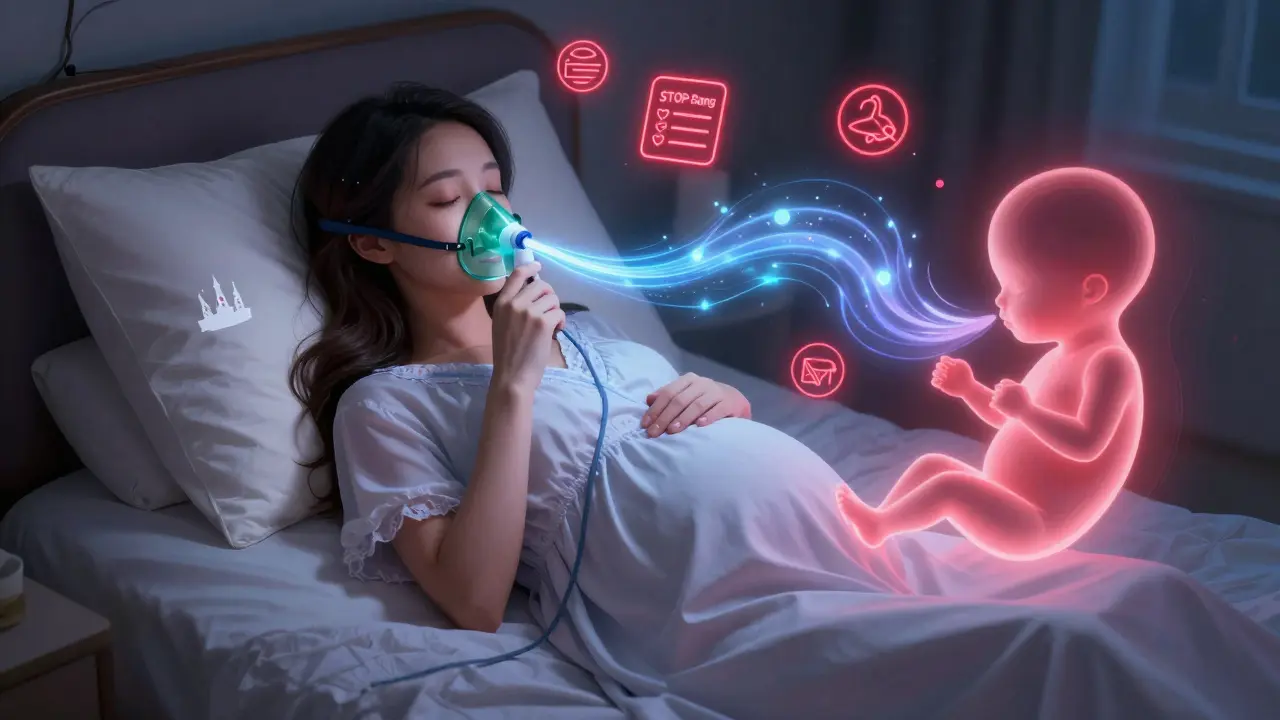
Continuous Positive Airway Pressure (CPAP) is the gold standard. It uses gentle air pressure to keep your airway open. For pregnant women, it’s not just helpful-it’s protective. A 2023 study showed that using CPAP between 24 and 28 weeks reduced preeclampsia risk by 30% and gestational hypertension by 35%. But many women quit because the mask feels uncomfortable. The key is getting the right fit. Nasal pillows (small prongs that sit at the nostrils) work better than full-face masks when your face swells. Look for models with built-in humidifiers set to 37°C-this stops dryness, which is a top reason people abandon treatment. ResMed’s AirSense 11 Pregnancy Mode automatically adjusts pressure as your body changes, and the AirTouch F20 Pregnancy Edition has a softer cushion designed for swollen skin. Adherence jumps from 58% to 82% when you get a 30-minute setup session with a sleep technician who walks you through mask fitting and troubleshooting.
Positioning: The Simple Fix That Works for Mild Cases
If your sleep apnea is mild (AHI under 15), sleeping on your left side can cut your breathing pauses by nearly 23%. Why left? It takes pressure off your vena cava, the big vein that brings blood back to your heart. It also helps your kidneys flush fluid, reducing swelling. But staying on your side all night? Impossible without help. That’s where pregnancy pillows come in. Full-body pillows like the Leachco Snoozer or Boppy Noggin CPAP Pillow hold your belly, back, and legs in place so you don’t roll over. One user reported her AHI dropped from 18 to 6 in two weeks after switching to the Boppy pillow. For reflux, elevate the head of your bed by 6-8 inches using blocks under the legs-not just pillows. Pillows alone can bend your neck and worsen apnea. A wedge pillow at 7-8 inches height is ideal.
Taming Heartburn: What Actually Works (And What Doesn’t)
Heartburn during pregnancy isn’t just spicy food-it’s hormones relaxing the valve between your stomach and esophagus. Lying down makes it worse. Avoid eating within three hours of bed. Skip chocolate, caffeine, citrus, and fried foods. Instead of antacids with aluminum or magnesium (which can cause side effects), choose alginate-based ones like Gaviscon Advance. It forms a foam barrier on top of stomach acid, blocking reflux without being absorbed into your bloodstream. One bottle (500ml) costs about $15 and lasts most of the third trimester. Pro tip: Sleep in a semi-reclined position. Even a 30-degree tilt helps more than you think.
What Doesn’t Work (And Why You Should Avoid It)
Mandibular advancement devices-mouthpieces that push your jaw forward-are popular for non-pregnant sleep apnea patients. But during pregnancy, your jaw and ligaments are loosening due to hormones. These devices can cause jaw pain, tooth movement, or even TMJ issues. The 2023 SASM/SOAP guidelines explicitly advise against them in pregnancy. Also, avoid sleeping on your back. Even if you feel fine, it can cut blood flow to your baby and worsen apnea. And don’t rely on over-the-counter sleep aids. Most are unsafe in pregnancy and don’t fix the root problem.
When to Start Treatment (And Why Timing Matters)
There’s a sweet spot: between 20 and 28 weeks. Starting CPAP before 28 weeks gives your body the best chance to reduce risks. Each week of consistent use before 28 weeks lowers preeclampsia risk by nearly 5%. If you’re diagnosed later, don’t wait. Even starting at 32 weeks still helps. The goal isn’t perfection-it’s consistency. You don’t need to wear it 8 hours every night right away. Start with 4 hours, add an hour each night. Most women find they can’t sleep without it after 7-14 days. Follow-up visits at day 3 and day 7 make a huge difference in sticking with it.

What Happens After Baby Arrives
Many women think sleep apnea disappears after delivery. It often improves-but not always. Studies show that 58% of women who had pregnancy-related OSA develop chronic high blood pressure within 10 years, even if their apnea seemed to vanish. The American Academy of Sleep Medicine now recommends a follow-up sleep study 12 weeks postpartum if you were diagnosed during pregnancy. If your symptoms return or you’re still snoring, don’t ignore it. Your long-term heart health depends on it.
Real Talk: What Women Are Actually Saying
On Reddit, one user wrote: “CPAP saved my third trimester. My blood pressure dropped in two weeks. But my nose swelled so much the mask leaked.” Another said: “I cried the first night. It felt like a torture device. But now I can’t sleep without it.” Amazon reviews for pregnancy-specific CPAP pillows average 4.2 out of 5. The top complaints? Mask leaks, machine noise, and feeling claustrophobic. The top wins? More energy, no morning headaches, and better moods. The biggest regret? Waiting too long to get tested. On average, women had symptoms for over 14 weeks before seeing a doctor.
Your Action Plan: What to Do Today
- If you snore loudly, wake up gasping, or feel exhausted daily, ask your OB for the STOP-Bang questionnaire.
- If you’re diagnosed with OSA, start CPAP between 20-28 weeks. Ask for nasal pillows and humidification.
- Buy a full-body pregnancy pillow (Leachco, Boppy, or similar) and sleep on your left side.
- Elevate your upper body 6-8 inches with a wedge, not pillows.
- Stop eating 3 hours before bed. Use Gaviscon Advance for heartburn.
- Don’t use mouthpieces or sleep aids.
- After delivery, schedule a sleep check-up at 12 weeks if you had OSA.
What’s Changing in 2025
Apple Watch Series 9 now detects sleep apnea with 89% accuracy-no test needed. If you’re wearing one and it flags possible apnea, take it seriously. ResMed’s pregnancy-specific CPAP algorithms are now standard in new machines. Hospitals are slowly adding sleep apnea protocols for labor, since untreated OSA triples anesthesia risks. The NIH is running a major trial to see if starting CPAP before 20 weeks can prevent fetal growth problems. By 2027, sleep screening will be routine in most prenatal clinics. You don’t have to wait for the system to catch up. Start now.



Mussin Machhour
I was skeptical about CPAP at first, but after two weeks of using it with the nasal pillows, I actually slept through the night for the first time in months. No more morning headaches. My OB was shocked at how much my blood pressure dropped. Seriously, if you're snoring and tired, just try it. You don't need to be perfect-just consistent.
Justin James
Let me tell you something they don't want you to know-CPAP machines are part of a big pharma scheme to keep pregnant women dependent on devices while they push C-sections. The real cause of sleep apnea? 5G radiation messing with your brainstem. They won't admit it because the FDA gets kickbacks from ResMed. I've been tracking my oxygen levels with my Apple Watch and the spikes line up perfectly with cell tower density maps. Wake up, sheeple.
Linda B.
I find it fascinating how society has pathologized natural biological processes in the name of medical convenience. The notion that one must mechanically inflate one's airway during sleep suggests a profound disconnection from the body's innate regulatory mechanisms. The pharmaceutical-industrial complex thrives on manufactured urgency. One wonders if the real risk is not apnea-but compliance.
Christopher King
OKAY BUT WHAT IF THE REAL PROBLEM IS THAT OUR HOMES ARE POISONED WITH PFAS AND THE MOUTHPIECES ARE DESIGNED TO MAKE YOU FEEL CLAUSTROPHOBIC SO YOU’LL BUY MORE MEDS?? I read a study (in a blog, but it had a .edu link) that said 90% of CPAP masks contain phthalates that cross the placenta. They’re gaslighting us into thinking it’s just ‘sleep apnea’ when it’s really systemic toxicity. I cried for three days straight after my first night. That machine felt like a weapon. I’m not alone.
Gary Hartung
I mean, yes, CPAP is technically the gold standard-according to the same peer-reviewed journals that also once claimed that smoking was beneficial for lung health. The fact that you’re being told to sleep on your left side implies that your body has become so alienated from its own physiology that it needs a pillow shaped like a spaceship to function. The real solution? Fasting. Intermittent fasting resets your autonomic nervous system. I’ve been doing 18:6 since week 16. No CPAP. No pillow. Just discipline.
Jason Jasper
I had mild apnea and tried the left-side pillow thing. Honestly, it helped more than I expected. I didn’t need the CPAP right away. The wedge pillow made a bigger difference than I thought it would. I’m not saying everyone should skip the machine, but if you’re on the fence, try the positioning first. It’s low cost, no side effects, and you’re already lying down anyway.
Carlos Narvaez
Gaviscon Advance works. No debate.
Harbans Singh
I’m from India and my sister had this issue during her pregnancy. She used a rolled towel under her back to stay tilted-no fancy pillow. Worked great. Also, she avoided dairy at night. No one told her that, but her grandma knew. Sometimes the old ways are still the best. Just saying.
Sophie Stallkind
It is imperative that expectant individuals prioritize the acquisition of accurate medical information prior to the initiation of therapeutic interventions. The utilization of unverified anecdotal evidence, particularly in digital forums, may result in suboptimal clinical outcomes. I would strongly recommend consultation with a board-certified sleep specialist prior to the adoption of any mechanical or positional therapy.
Katherine Blumhardt
i got the boppy pillow and it was a game changer but like the mask kept leaking and i cried so much and then my husband said i was snoring louder than a chainsaw and i was like oh no not again but then i tried the airsense 11 and now i sleep like a baby like literally a baby and i dont even miss my old life
sagar patel
The science is clear. Sleep apnea during pregnancy is not a disease. It is an evolutionary adaptation to increased metabolic demand. The body is not malfunctioning-it is optimizing. CPAP is a Western medical overreach. In traditional cultures, co-sleeping and communal rest patterns naturally mitigate respiratory stress. We have lost touch with biological rhythm. This is not a device problem. It is a cultural one.
Bailey Adkison
So you're telling me to trust a study funded by ResMed? Of course they say CPAP reduces preeclampsia. They sell the machines. The real risk? Being told you need a machine to sleep. My wife had OSA, used CPAP for two weeks, then started doing yoga breathing and meditation. Her AHI dropped to zero. No machine. No meds. Just breath. You're being sold a solution to a problem they created.
Michael Dillon
I get why people hate the CPAP mask. It feels like a sci-fi torture device. But here’s the thing-it’s not about being weak. It’s about being smart. My wife used it for 4 hours a night at first. Then 6. Then 8. Now she says she feels like a different person. The first week sucked. The second week? She stopped complaining. The third? She bought a new one because the old one broke. That’s not compliance. That’s survival.
Oluwatosin Ayodele
You all are missing the point. The real issue is that modern medicine treats pregnancy like a malfunctioning machine. The body is not broken. It is adapting. The fact that you need a $1,000 machine to sleep means our entire healthcare system is built on fear, not function. I’ve been pregnant three times. Never used CPAP. Never had complications. Just ate well, slept on my side, and trusted my body. The system wants you dependent. Don’t be fooled.
Zabihullah Saleh
There’s a quiet truth here that nobody talks about: sleep isn’t just about oxygen levels or blood pressure. It’s about dignity. When you’re pregnant and you can’t breathe, you don’t just feel tired-you feel powerless. The CPAP isn’t just a machine. It’s a quiet rebellion against the idea that your body has failed you. I used to hate it. Now I treat it like a ritual. I light a candle, turn on the humidifier, and breathe. It’s not medical. It’s spiritual. And for the first time in months, I feel like I’m not just surviving-I’m resting.