
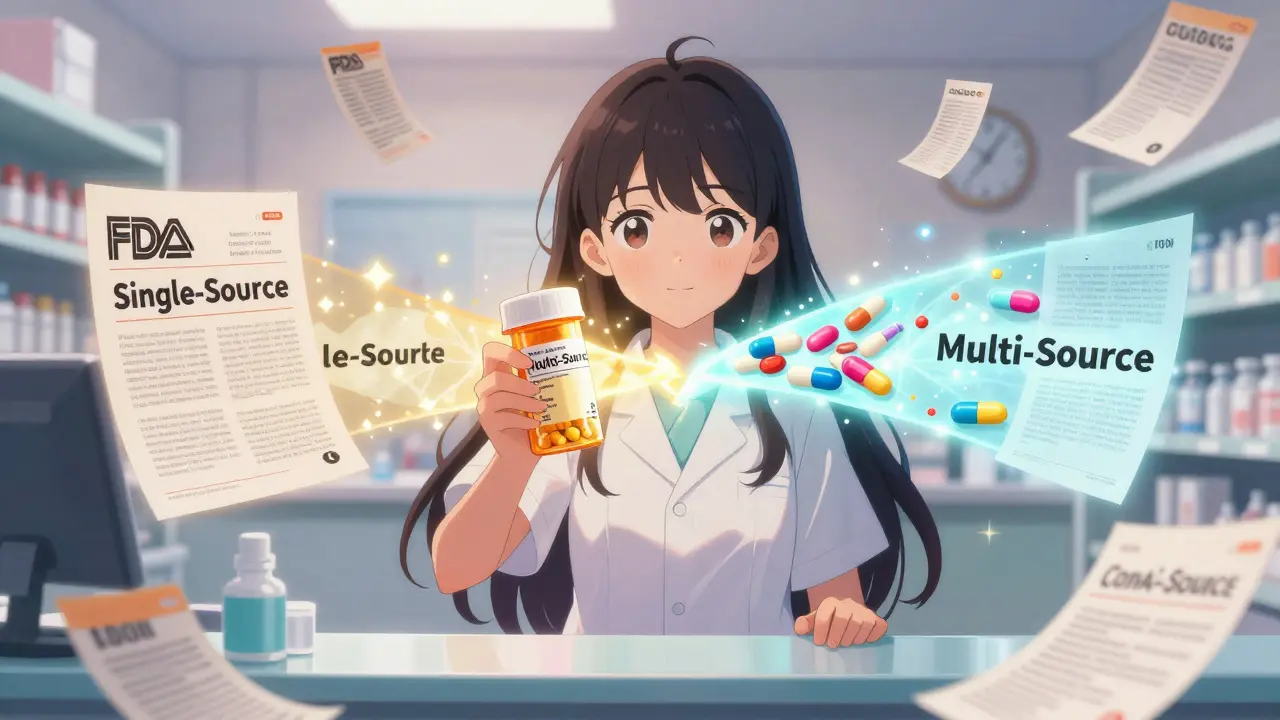
Have you ever picked up a prescription and noticed your pill looks different this time? Or been told your insurance won’t cover the brand you’re used to, and you have to switch to a cheaper version? If so, you’re dealing with the difference between single-source and multi-source drugs-and it matters more than most patients realize.
What’s the difference between single-source and multi-source drugs?
A single-source drug is a medication made by only one manufacturer, with no generic versions available. These are often newer drugs still under patent protection, like certain cancer treatments or specialty medications for rare conditions. Because there’s no competition, the manufacturer sets the price with little pressure to lower it.
Multi-source drugs are the opposite: they’re available as both the original brand name and multiple generic versions from different companies. Think of common medications like lisinopril for high blood pressure or metformin for diabetes. Once the patent expires, other companies can make identical versions-so long as they meet strict FDA rules.
The FDA tracks this using its Orange Book, which only lists therapeutic equivalence codes for multi-source drugs. Single-source drugs don’t get these codes because there’s nothing to compare them to.
Why does this affect your out-of-pocket costs?
Let’s cut to the chase: multi-source drugs are almost always cheaper. In 2023, about 90% of prescriptions filled in the U.S. were for multi-source drugs, but they made up only 23% of total drug spending. That’s because generics cost far less.
On average, patients pay $132 per month for a multi-source drug, compared to $587 for a single-source drug. That’s more than four times the cost.
But here’s the twist: just because a drug is generic doesn’t mean it’s automatically cheap. Some single-source drugs have a twist-they’re called single-source generics. That’s when one company gets exclusive rights to make the generic version, with no other competitors. In those cases, prices don’t drop much. Truveris found in 2022 that these "exclusive generics" often cost nearly as much as the brand name.
Insurance companies know this. They use something called Maximum Allowable Cost (MAC) to set what they’ll pay for generics. MAC is usually 50-60% below the brand’s list price. But for single-source drugs? No MAC limit applies. That means you pay the full price unless your insurer has a special deal.
Are generics really the same as brand-name drugs?
The FDA says yes. To get approved, a generic must contain the same active ingredient, in the same strength, and delivered the same way (pill, injection, etc.) as the brand. It also has to be bioequivalent-meaning your body absorbs it at the same rate and amount, within a strict 80-125% range.
That sounds solid. And for most people, it works perfectly fine.
But here’s what patients report on Drugs.com: 68% of negative reviews for generic drugs mention "inconsistent effectiveness" between different manufacturers. That doesn’t mean the FDA got it wrong. It means that even tiny differences in inactive ingredients-like fillers, dyes, or coatings-can affect how some people feel. For example, someone with a sensitive stomach might react differently to one generic version versus another.
And then there’s the switch. In 2022, 63% of people on multi-source drugs got a different generic manufacturer without warning. Why? Because PBMs (pharmacy benefit managers) change contracts to get the lowest price. Your pharmacy might give you a pill from Company A this month, and Company B next month. The FDA says it shouldn’t matter. But if you’ve been stable on one version for years, a sudden switch can feel unsettling.
What about insurance and step therapy?
Most insurance plans don’t let you start with a single-source drug. They require you to try the cheaper generic first. This is called step therapy. If the generic doesn’t work-or causes side effects-you can appeal. But that means extra paperwork, calls to your doctor, and sometimes weeks of delay.
Single-source drugs are often placed on the highest tier of your plan’s formulary. That means higher copays or coinsurance. You might pay 30% of the cost instead of $10.
Some insurers even stop covering the brand name entirely once generics are available. That’s not a mistake-it’s policy. They’re pushing you toward the cheaper option.
What should you do as a patient?
- Ask your pharmacist if your drug is single-source or multi-source. If it’s multi-source, ask if the manufacturer changed. You have the right to know.
- Check your formulary online. Your insurer’s website should list which drugs are covered and at what cost tier.
- Don’t assume generics are perfect. If you notice new side effects after a switch, tell your doctor. It’s not "all in your head."
- Use the FDA’s resources. Their "Understanding Generic Drugs" page explains everything clearly, with real examples.
- Ask about cost-saving options. Some drugmakers offer patient assistance programs-even for brand-name drugs. And mail-order pharmacies often have better prices than local ones.
Why do prices keep rising on multi-source drugs?
You might be surprised: in 2023, multi-source drug prices went up 26%, while single-source drugs rose just 7.4%. That sounds backwards, right? But here’s why it happens.
When multiple companies make the same drug, they compete on price. But they also compete on rebates. PBMs and insurers demand discounts, and manufacturers respond by cutting prices-but also raising list prices to offset those discounts. The result? A game of financial tug-of-war that doesn’t always help the patient.
As Dr. Erin Trish from the USC Schaeffer Center said: "Higher list prices generate larger rebates, but these savings rarely translate to lower out-of-pocket costs for patients."
So even though multi-source drugs are cheaper than brands, they’re not immune to price hikes. The system is complex-and often opaque.
What’s changing in 2026?
The FDA is speeding up generic approvals. Under the 2023 Generic Drug User Fee Amendments (GDUFA III), the goal is to approve generics in 10 months or less. That means more single-source drugs will become multi-source faster.
Take Humira, for example. For 14 years, it was a single-source blockbuster. Then, in 2023, multiple generics hit the market. Prices dropped by over 70% almost overnight.
But drugmakers aren’t giving up. Some now release their own "authorized generics"-brand-name versions made by the same company but sold under a generic label. It’s a way to keep profits while appearing to support competition.
And with the Medicare Part D inflation penalty now in effect, manufacturers of high-priced single-source drugs face financial penalties if they raise prices faster than inflation. That could force more price freezes-or faster transitions to generics.
Bottom line: You’re not alone, and you have options
Knowing whether your drug is single-source or multi-source isn’t just about pharmacy jargon. It’s about your wallet, your health, and your peace of mind.
Most of the time, generics are safe, effective, and way cheaper. But not always. If you’ve had a bad experience with a switch, you’re not imagining it. Talk to your pharmacist. Ask your doctor. Don’t accept "it’s the same" as a final answer.
And remember: you have rights. You can request the same generic manufacturer. You can appeal a formulary denial. You can ask for patient assistance. The system is stacked against transparency-but you’re not powerless.
Are generic drugs really as effective as brand-name drugs?
Yes, by FDA standards. All generic drugs must prove they deliver the same active ingredient in the same amount and at the same rate as the brand name. This is called bioequivalence, and it’s tested with strict scientific standards. For most people, generics work just as well. But some patients report differences in side effects or effectiveness, often due to inactive ingredients or changes in manufacturer. If you notice a change after switching, talk to your pharmacist or doctor.
Why does my generic drug look different every time I fill it?
Because your pharmacy gets its supply from different manufacturers based on which one offers the lowest price to your insurance plan. This is common with multi-source drugs and happens in about 63% of cases, according to a 2022 report. The FDA says this doesn’t affect safety or effectiveness, but if you’re sensitive to pill coatings or fillers, you might feel a difference. You can ask your pharmacist to order the same manufacturer, though they may not always be able to.
Can I ask my doctor to prescribe a brand-name drug instead of a generic?
Yes, but your insurance may not cover it. Your doctor can write "Dispense as Written" or "Do Not Substitute" on the prescription. This tells the pharmacy to give you the brand name. But if there’s a generic available, you’ll likely pay a lot more out of pocket. Insurance companies usually require you to try the generic first before approving the brand.
What’s the difference between a single-source generic and a regular generic?
A regular generic has multiple manufacturers competing to make the same drug, which drives prices down. A single-source generic means only one company is allowed to make the generic version-usually because of a legal agreement or patent extension. In those cases, prices don’t drop much, and the drug acts more like a brand-name product in terms of cost. These are sometimes called "exclusive generics," and they’re becoming more common.
How do I find out if my drug is single-source or multi-source?
Ask your pharmacist-they have access to databases like Medi-Span that classify drugs by source. You can also check the FDA’s Orange Book online (search by drug name). If you see multiple manufacturers listed, it’s multi-source. If only one manufacturer is listed and no generics appear, it’s likely single-source. Your insurance formulary may also label it as "brand-only" or "generic available."
Next steps for patients
- Review your monthly prescriptions. Are you on a single-source drug? If so, ask if a generic is available.
- Call your pharmacy and ask: "Which manufacturer made my last refill?" Write it down. If it changes unexpectedly, note it.
- Check your insurer’s formulary website. Look up your drug and see what tier it’s on.
- Visit the FDA’s website for clear, unbiased info on generics.
- If you’re struggling to afford your meds, ask about patient assistance programs. Many drugmakers offer them-even for brand-name drugs.


Elan Ricarte
Let’s be real - the system is rigged. I’ve been on the same generic for three years, and last month my pharmacy switched me to a new batch that made me feel like I’d been hit by a bus. No change in active ingredient? Cool. But the filler? Some kind of chalky nonsense that tastes like regret. My stomach’s been in revolt since. FDA says it’s ‘bioequivalent’ - yeah, right. Like my body doesn’t know the difference between a Porsche and a knockoff that looks the same but shakes apart at 30 mph.
Angie Datuin
I just wanted to say thank you for writing this. My mom’s on a single-source drug for her autoimmune condition, and we’ve been struggling to afford it. I didn’t realize how common these ‘exclusive generics’ are - that’s wild. I’m going to call her pharmacist tomorrow and ask if they can stick with the same manufacturer. Small wins, you know?
Camille Hall
As someone who works in patient advocacy, I see this every day. The real issue isn’t just the science - it’s the lack of transparency. Patients aren’t told when their drug switches manufacturers, and they’re not given the tools to push back. Pharmacies don’t have to notify you. Insurers don’t have to explain why. And doctors? They’re overwhelmed. We need better labeling on the bottle - not just ‘generic’ but ‘Made by X Pharma, Switched from Y Pharma.’ Simple. Human. Necessary.
Ritteka Goyal
OMG I’m from India and we have the BEST generic system here!! Like, we make 20% of the world’s generics - and they’re CHEAPER than water! Why can’t America just copy us? We don’t have this drama with ‘single-source generics’ - if a drug is off-patent, 10 companies make it and prices CRASH. Also, our pharmacists actually TALK to you. Not like here where they just hand you a pill like it’s a coupon. #MakeAmericaGenericAgain
Monica Warnick
So I got switched to a generic last month and now I’m having panic attacks. I swear, it’s not in my head. I’ve been on the brand for 7 years. I started crying in the pharmacy aisle. I called my doctor. They said ‘it’s the same chemical.’ But what if my soul doesn’t recognize it? What if my body remembers the brand? This isn’t science - it’s emotional trauma wrapped in a pill bottle.
Ashlyn Ellison
My pharmacy just switched my metformin to a new maker. I didn’t notice anything. Maybe I’m just chill. Or maybe I’m numb. Either way, I’m not complaining. If it works, it works. I’ll take the $10 over the $120 any day.
Jonah Mann
Wait - so the FDA’s Orange Book doesn’t list single-source drugs? That’s wild. And I thought I knew everything about this stuff. Also - typo alert: ‘Truveris found in 2022’ - should be ‘Truveris found in 2022.’ And ‘PBMs’? Pharmacy Benefit Managers - spell it out once. And bioequivalence? 80-125%? That’s a HUGE range. Like, if I take a pill that’s 125% absorbed, I’m basically getting 25% more drug than intended. That’s not ‘equivalent’ - that’s a gamble.
Tricia O'Sullivan
Thank you for this thoughtful and meticulously researched piece. The systemic opacity surrounding drug sourcing is not merely a logistical challenge but a profound ethical failure. Patients are rendered passive recipients within a market structure that prioritizes rebate economics over therapeutic continuity. The absence of mandatory manufacturer disclosure on prescriptions constitutes a breach of informed consent. I respectfully urge policymakers to institute a standardized, patient-facing drug origin label - akin to nutritional information on food.
Tatiana Barbosa
Y’all need to stop treating generics like they’re magic. They’re not. They’re just cheaper versions of the same drug - and sometimes that matters. I had a patient last week who went from brand to generic and started having seizures. Not kidding. Turned out the new generic had a different filler that triggered her rare allergy. She’s fine now - but she almost didn’t make it. If your doc says ‘it’s the same,’ ask them: ‘Have you ever seen someone have a reaction to a switch?’ They’ll pause. Then they’ll start Googling.
Andrew Jackson
Let’s not pretend this is about health. This is about corporate greed disguised as policy. The FDA is a puppet of Big Pharma. The Orange Book? A joke. Single-source drugs? Protected monopolies. Multi-source? A shell game where the only winner is the PBM. And you? You’re the sucker paying $132 for a pill that should cost $5. This isn’t capitalism - it’s feudalism with a pharmacy counter.
Joseph Charles Colin
From a clinical pharmacology standpoint, bioequivalence thresholds (80–125%) are statistically sound for population-level outcomes, but they are not individualized. The intra-individual variability in absorption can be as high as 30% in certain phenotypes - especially CYP450 poor metabolizers. When you compound that with excipient variability - particularly in enteric coatings or disintegrants - you’re introducing a confounding variable that’s rarely monitored. This is why therapeutic drug monitoring (TDM) should be standard for narrow-therapeutic-index drugs during generics transitions. It’s not paranoia - it’s precision medicine.
Tom Forwood
As a Filipino-American who’s had to navigate both U.S. and PH healthcare, I can tell you - this is universal. In the Philippines, generics are the norm and people get them without drama. Here? You need a PhD just to understand why your pill changed color. I had my abuela switch from brand to generic and she swore the new one made her dizzy. Turns out, it had titanium dioxide - a dye she’s allergic to. No one told her. No one even asked. We need better communication. Not just info - connection.
John McDonald
Look - I get it. You want to save money. But if your body says ‘no,’ listen. I switched my dad to a generic for his heart med. He was fine for two weeks. Then he started getting chest tightness. We switched back. Gone in 48 hours. The pharmacy said ‘it’s the same.’ I said ‘then why did his body scream?’ Sometimes the science doesn’t match the lived experience. And that’s okay. Your health isn’t a spreadsheet.
Andy Cortez
So let me get this straight - the government lets a company make a generic version of a drug… and then gives them exclusive rights so they can charge the same price as the brand? That’s not competition - that’s fraud. And now they’re calling it an ‘authorized generic’? That’s like calling a fake Rolex ‘authentic.’ You’re not lowering prices - you’re just rebranding the scam. Wake up. This isn’t healthcare. It’s a Ponzi scheme with a stethoscope.
Jacob den Hollander
Just wanted to say - I read this whole thing and cried. Not because I’m emotional - but because I’ve been there. My daughter has epilepsy. We’ve been on the same generic for 5 years. Last month, the pharmacy switched. She had 3 seizures in 48 hours. We called the doctor. They said ‘it’s bioequivalent.’ We called the pharmacy. They said ‘we don’t control who makes it.’ We called the manufacturer. They said ‘we don’t supply that pharmacy.’ We were stuck. We ended up paying out of pocket for the brand. No one helped. No one even apologized. If you’re reading this - don’t give up. Keep asking. Keep documenting. You’re not crazy. The system is broken.