
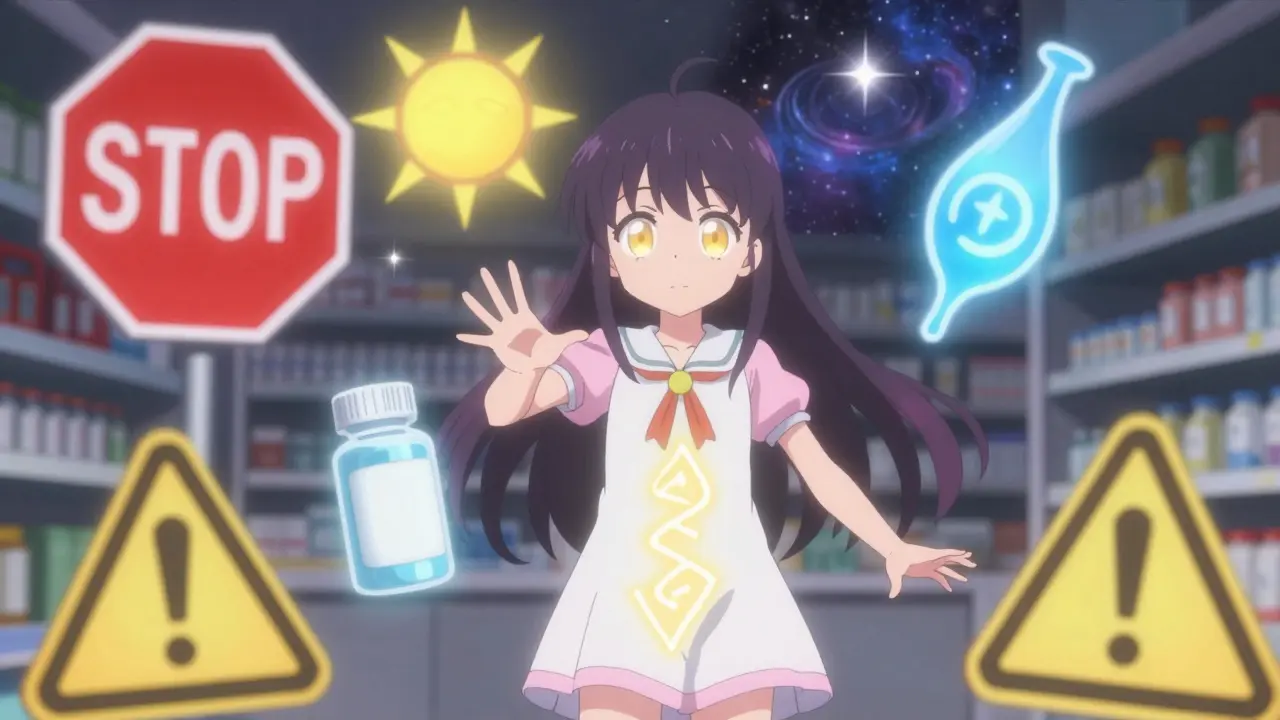
When you pick up your prescription, you might not think much about the small stickers on the bottle. But those icons - the red stop sign, the yellow sun, the blue dropper - are there for a reason. They’re not decoration. They’re your last line of defense against a dangerous mistake. A 2021 Consumer Reports study found that 52% of Americans misinterpret at least one common warning on their medication labels. That’s more than half of all patients. And when you mix up a warning, the consequences can be serious: drowsiness while driving, dangerous drug interactions, or even hospitalization.
What Do These Icons Actually Mean?
Pharmacy warning icons are visual shortcuts. They’re designed to communicate critical safety info quickly, especially for people who may not read well, speak English as a second language, or are just overwhelmed by medical jargon. The most common ones you’ll see are standardized across most U.S. pharmacies, thanks to efforts led by the Institute for Safe Medication Practices (ISMP) since the 1990s. By 2022, about 90% of prescription containers in the U.S. carried at least one of these standardized labels.Here’s what the big ones usually mean:
- Yellow sticker: "This medicine may make you sleepy. Don’t drive or operate machinery." This is one of the most common warnings, especially for antidepressants, painkillers, and allergy meds.
- Red stop sign: "Do not take with alcohol." This one’s serious. Mixing certain meds with alcohol can cause liver damage, extreme drowsiness, or even fatal breathing problems.
- Blue dropper: "For external use only." A simple icon, but confusing to many. One study found nearly 70% of patients thought this meant "use on skin," but didn’t realize it meant "do not swallow."
- White sun: "Take on an empty stomach." This isn’t just advice - it’s science. Food can block absorption of antibiotics like amoxicillin or thyroid meds like levothyroxine.
- Green clock: "Take with food." This protects your stomach from irritation (like with ibuprofen) or helps your body absorb the drug better (like some cholesterol meds).
Color matters too. A 2019 study in U.S. Pharmacist showed that 42% of patients automatically think red = danger, yellow = caution, and white/green = "it’s fine." That’s why red and yellow are reserved for the highest-risk warnings. But here’s the problem: not all pharmacies use the same colors. Some use tan for antibiotics, others use orange. That inconsistency causes confusion.
Why Do So Many People Get It Wrong?
You’d think these symbols are obvious. But they’re not. A 2020 study in the Journal of Health Communication found that 68.3% of patients with low health literacy misread the "radioactive" symbol (used to mean "external use only"). They thought it meant the medicine was dangerous to touch or that it contained radiation.Even simple phrases trip people up. "Do not chew or crush, swallow whole" was misunderstood by over half of patients in one study. Many thought it meant "don’t swallow at all." Another common mix-up: "Take with food." Some patients believed it meant "take during a meal," when it really means "take within 30 minutes of eating" - a subtle but critical difference.
And then there’s clutter. A 2020 FDA survey found that 63.4% of patients said their labels had too many stickers. When you’re bombarded with five or six warnings, your brain starts tuning them out. Pharmacists often over-label out of caution, but that backfires. Research from the Journal of the American Pharmacists Association shows that when more than three warnings are used, patients pay attention to fewer than half of them.

Differences Between Pharmacies - And Countries
Not all pharmacies use the same system. CVS Health uses 14 standardized warning icons. Walgreens uses 17. Independent pharmacies? On average, they use 23 different ones. That’s chaos. A patient who switches pharmacies might get completely different labels for the same drug. No wonder confusion is so high.Compare that to the U.K., where a single national system of just 9 warning labels was rolled out in 2015. Misinterpretation rates dropped from 39% to 17%. New Zealand’s standardized yellow Cautionary and Advisory Labels (CALs), introduced in 2018, show 22% better patient understanding than the U.S. system.
In the U.S., there’s no federal law forcing all pharmacies to use the same icons. The FDA has been pushing for standardization since 2022, proposing 12 core warning symbols to be mandatory by 2026. CVS and Walgreens have already pledged to align with this plan. But until then, you’re playing a guessing game.
What’s Being Done to Fix It?
The system isn’t broken - it’s just outdated. Experts agree: warning icons are necessary, but they’re not enough on their own.Dr. Michael Cohen of ISMP says: "Standardized labels are necessary but insufficient without proper patient counseling." That’s why leading pharmacies now pair visual warnings with verbal explanations. A 2022 study found that when pharmacists verbally explain the label, comprehension jumps by 63%.
Technology is helping too. Some pharmacies now include QR codes on labels that link to short videos showing how to take the medicine. Kaiser Permanente tested augmented reality labels in 2022 - patients pointed their phone at the bottle and saw a 3D animation of the correct dosage. Comprehension rose from 58% to 89%.
But not everyone has a smartphone. The Pew Research Center found that 24% of seniors don’t use one regularly. So digital fixes can’t replace clear, simple, physical labels.
What You Can Do Right Now
Don’t assume you understand the label. Here’s how to protect yourself:- Ask the pharmacist - even if you’ve taken the medicine before. Warnings can change if your dose changes or if you start a new drug.
- Point to the icon and say, "What does this mean?" Don’t be shy. Pharmacists expect this.
- Check for color - red and yellow mean high risk. If you’re unsure, treat it like a red light.
- Don’t ignore clutter - if there are too many stickers, ask which ones are most important.
- Take a photo of the label if you’re worried about forgetting. Show it to a family member or caregiver.
One Reddit user shared how her mother took eye drops orally because she thought the dropper icon meant "take by mouth." That’s the kind of mistake that ends in the ER. It’s preventable.
Why This Matters
Medication errors tied to confusing labels contribute to at least 7,000 deaths a year in the U.S., according to the FDA. They also cost the healthcare system $21.3 billion annually in avoidable hospital visits and treatments.Standardized warning icons save lives. But only if you understand them. And only if they’re clear, consistent, and paired with real human guidance. The system is evolving - faster than ever. By 2026, the U.S. will likely have its first national standard. Until then, don’t rely on symbols alone. Ask. Double-check. Speak up. Your safety depends on it.
Why do some pharmacy labels have different colors for the same warning?
There’s no federal law in the U.S. requiring all pharmacies to use the same color system. CVS, Walgreens, and independent pharmacies each developed their own label sets over time. While most use yellow for drowsiness and red for alcohol warnings, some use orange, tan, or blue. This inconsistency confuses patients who switch pharmacies or get prescriptions from different providers. The FDA is pushing for national standardization by 2026 to fix this.
Can I ignore a warning if I’ve taken the medicine before without problems?
No. Warnings aren’t based on your past experience - they’re based on how the drug works with your body and other substances. For example, a sedative might not have made you sleepy last time, but if you started a new antidepressant or stopped drinking coffee, the effect could be stronger now. Also, warnings like "take on empty stomach" are about how your body absorbs the drug, not how you feel. Always follow the label, even if you think it doesn’t apply.
What should I do if I don’t understand a symbol on my label?
Call the pharmacy or ask the pharmacist before you take the medicine. Don’t guess. If you’re uncomfortable asking in person, call back later. You can also look up the drug name and "warning label" on the FDA website or the ISMP’s free resources. Never assume the symbol means what you think it does - studies show even common symbols like "external use only" are misunderstood by two out of three patients.
Are warning labels the same for generic and brand-name drugs?
Yes, the safety warnings should be identical. Generic drugs contain the same active ingredient as brand-name versions, so the risks and instructions are the same. But the physical label - including the icons - might look different depending on which pharmacy fills it. Always compare the warning icons and text, not just the drug name.
Do children and older adults need different warning labels?
Not in design - the same icons are used for everyone. But pharmacists are supposed to tailor explanations. For older adults, they should check vision and hearing. For children, they should confirm how the dose is measured (teaspoon? dropper?). Some pharmacies now offer large-print labels or audio instructions for seniors, but this isn’t standard yet. Always ask for clarification if you’re caring for someone with limited vision, hearing, or literacy.




Lauren Volpi
So let me get this straight - we’re relying on stickers like some kind of visual Morse code for life-or-death stuff? And the government can’t just make one standard? I mean, come on. We put satellites in orbit but can’t agree on a stop sign for pills? This isn’t healthcare. It’s a glitch in the matrix.
Manish Singh
In India, we don’t even have these icons. Pharmacies just hand you a paper with tiny text. My grandma took her blood pressure med with grapefruit because the label said 'avoid citrus' - she thought citrus meant oranges, not the whole fruit family. No one explained. No one cared. These symbols? They’re a start. But they’re useless if no one teaches you how to read them.
Nilesh Khedekar
you know what this is really about? big pharma and the fda want you confused so you keep coming back. they dont want you to understand the meds. they want you scared. think about it - if you knew exactly what each icon meant, youd stop taking them when you felt better. but with all these weird symbols? you stay hooked. and the qr codes? thats how they track you. your phone scans it, they know you took it, they sell that data. its all connected. i saw a documentary.
Robin Hall
The current pharmacovigilance infrastructure in the United States exhibits a profound structural deficiency in standardization protocols. The absence of a federally mandated, uniformly implemented visual lexicon for pharmaceutical warnings constitutes a systemic failure in risk communication. This is not merely an inconvenience - it is a public health liability of quantifiable magnitude, resulting in preventable morbidity and mortality. A regulatory intervention is not merely advisable - it is ethically imperative.
jared baker
Look, it’s simple. Red = stop. Yellow = slow down. Blue = don’t swallow. Green = eat first. White = take alone. If you’re not sure, ask. That’s it. No need to overthink it. Pharmacists aren’t there to stare at you - they’re there to help. Just say, 'Hey, what’s this one mean?' They’ve heard it a thousand times. No shame.
Michelle Jackson
I work at a pharmacy and let me tell you - patients read these labels like they’re horoscopes. One guy asked if the dropper meant he should use it as a straw. Another refused his antibiotic because the sun icon made him think it was 'solar powered.' We have to explain everything. Twice. And still, half the time they walk out thinking they know better. It’s exhausting. And honestly? It’s not the icons. It’s the people.
Suchi G.
I’ve been on so many meds over the years - antidepressants, painkillers, thyroid, blood thinners - and every time I pick up a new bottle, I feel this wave of dread. Like, what if I miss something? What if I don’t understand the symbol? What if I take it wrong and my body just… gives up? I’ve cried in the pharmacy aisle before. Not because I’m weak. Because the system doesn’t care if you’re scared. It just throws stickers at you and says 'figure it out.' And then you’re supposed to be grateful you’re alive. It’s not healthcare. It’s emotional labor with a side of risk.
becca roberts
So we’ve got QR codes and AR animations now? That’s great. Next they’ll be installing TikTok filters on pill bottles. 'Swipe left to avoid liver damage!' Look, I get tech is cool. But my aunt’s 78 and still uses a flip phone. She doesn’t want to scan a code. She wants someone to look her in the eye and say, 'This one? Don’t mix with wine.' That’s the magic. Not pixels. Not icons. Just a human voice.
Andrew Muchmore
Ask the pharmacist. Always. No exceptions. That’s the rule. Everything else is noise.