

The VA formulary isn’t just a list of approved drugs-it’s the backbone of how millions of veterans get affordable, consistent medication across the U.S. If you’re a veteran relying on VA healthcare, understanding this system means knowing exactly what you’ll pay, what you’ll get, and how to navigate changes without surprise bills.
How the VA Formulary Works: Generic First, Always
The VA National Formulary is mandatory. Every VA clinic, hospital, and pharmacy must stock the same medications. And here’s the key rule: if a generic version exists, that’s what you get. No exceptions unless your doctor proves you need the brand name for medical reasons. This isn’t just policy-it’s law-driven efficiency. The VA spends about $1,850 per veteran on medications each year. Compare that to $2,700 for someone with private insurance. The reason? Generics. The VA uses them in 92% of cases, far above the national average of 89%. That’s not luck. It’s a system built to cut waste without cutting care.The Three Tiers: What You Pay Matters
Your out-of-pocket cost depends on which tier your drug falls into. There are only three tiers, and it’s simpler than Medicare Part D’s five-tier mess.- Tier 1: Preferred generics. These cost you $5 to $10 for a 30-day supply. Most common drugs like aspirin, ibuprofen, atorvastatin, and sertraline are here.
- Tier 2: Non-preferred generics or some brand-name drugs with generic alternatives. Copays jump to $15-$20.
- Tier 3: Brand-name drugs with no generic version. These cost $30-$50. You’ll only hit this tier if there’s truly no generic option.
What’s Covered in 2025? Key Tier 1 Drugs
The VA updates its formulary monthly, but Tier 1 stays mostly stable. Here’s what’s included as of October 2025:- Arthritis & Pain: Allopurinol, ibuprofen, aspirin buffered
- Cholesterol: Atorvastatin, pravastatin, ezetimibe
- Heart & Blood Pressure: Furosemide, hydrochlorothiazide
- Mental Health: Fluoxetine, sertraline, trazodone
- Bone Health: Alendronate (Fosamax generic)
How to Check If Your Drug Is Covered
You don’t have to guess. Use the VA Formulary Advisor. Type in your drug name-brand or generic-and it tells you:- Which tier it’s on
- Whether it’s covered
- If prior authorization is needed
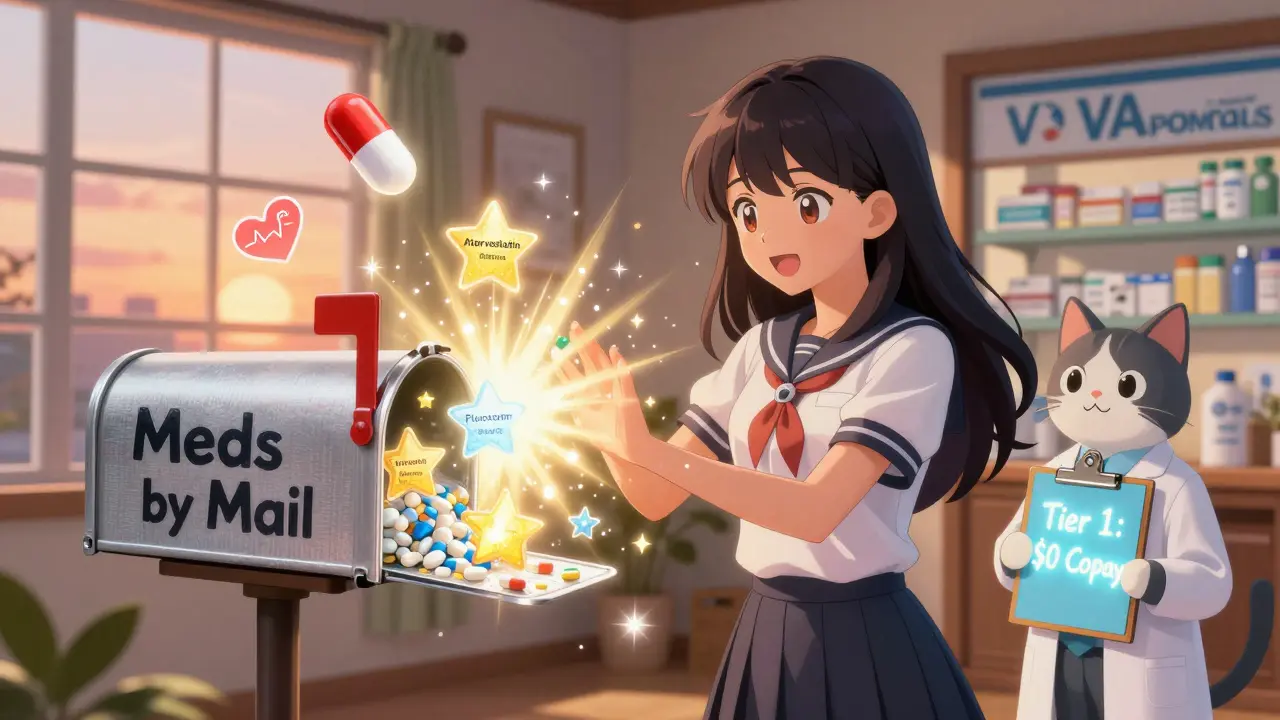
Meds by Mail: Free Delivery, Zero Copay
If you’re on long-term meds, use Meds by Mail. It’s free. No deductible. No copay. You get a 90-day supply mailed to your door. For veterans on Tier 1 drugs, that’s $0 out of pocket. A 2024 survey of 12,450 users found 87% were satisfied with the service. One veteran wrote: “Switched to generic sertraline through Meds by Mail. Same as Zoloft, but $0. My local pharmacy wanted $15.” The catch? Refrigerated drugs like insulin or biologics can’t be shipped. You’ll need to pick those up at a VA pharmacy.When You Need Something Not on the Formulary
Sometimes, your doctor wants a drug that’s not on the list. Maybe it’s newer. Maybe it’s for an off-label use. You’ll need prior authorization. Your provider submits paperwork. The VA reviews it based on clinical evidence, cost, and alternatives. It’s not automatic. But it’s not impossible either. A common pain point? Weight-loss drugs like Wegovy or Ozempic. The VA covers them-but only for type 2 diabetes, not for weight loss alone. A veteran on the Veterans Benefits Network forum wrote in November 2025: “My doctor wanted me on Wegovy for weight management. VA said no unless I have diabetes.” That’s the trade-off. The VA is strict. But they’re also transparent. Every denial comes with a written reason.CHAMPVA and the VA Formulary: What’s Different?
CHAMPVA covers dependents and survivors of veterans. Their formulary follows the same rules-but with a few twists. As of January 2025, CHAMPVA covers GLP-1 drugs (like Ozempic, Mounjaro) only for FDA-approved uses: diabetes, sleep apnea, or heart disease risk. Weight loss alone? Not covered. This isn’t arbitrary. It’s based on clinical guidelines and cost control. The VA doesn’t cover drugs just because they’re trendy. They cover them because they work, and the data says they’re worth it.
Why the VA Formulary Works Better Than Private Insurance
Private insurers change tiers constantly. A drug might be Tier 2 one month, Tier 4 the next. The VA doesn’t do that. Their tiers are reviewed once a year. Changes happen monthly, but they’re small-adding a new generic, removing a drug that’s no longer safe. The result? Predictability. Veterans know what they’ll pay. No bill shocks. No surprise denials. Plus, the VA’s drug prices are negotiated nationally. They buy in bulk. That’s why a 30-day supply of atorvastatin costs $5 at the VA and $40 at CVS.Common Problems and How to Fix Them
New veterans often get confused. Here’s what trips people up:- “Why did my prescription change?” Because the VA switched to a cheaper generic. It’s the same drug. Same effect.
- “I can’t get my old brand.” You can, but only if your doctor proves it’s medically necessary. Fill out the prior auth form.
- “I’m confused about tiers.” Use the Formulary Advisor. Talk to your VA pharmacist. They help 78% of new enrollees navigate this.
What’s Coming in 2026
The VA is upgrading its system. By Q3 2026, the electronic health record will suggest generic alternatives automatically when a prescriber writes a brand-name drug. Think of it like a smart assistant saying: “This drug has a cheaper, equally effective generic. Want to switch?” They’re also expanding access to specialty drugs for cancer and rare diseases. Costs are rising, but the VA is staying ahead. They’re investing in pharmacogenomic testing-using your DNA to pick the right drug the first time. Less trial and error. Less waste.Final Thoughts: It’s Not Perfect, But It’s Fair
The VA formulary isn’t designed to give you every drug on the market. It’s designed to give you the right drug at the lowest cost. And for 9 million veterans, that’s enough. Yes, you might have to wait for prior auth. Yes, you might get a generic you didn’t expect. But you won’t get hit with a $500 bill for a month’s supply of blood pressure medicine. You won’t have to choose between meds and rent. That’s the real value. Not the fancy new drugs. Not the marketing hype. Just reliable, affordable care.Are all VA prescriptions generic?
No, but the VA defaults to generic medications when they’re available and equally effective. Brand-name drugs are only prescribed if a veteran has a documented medical reason-like an allergy or adverse reaction to the generic version. Your doctor must request prior authorization for brand-name drugs not on the formulary.
How do I check if my medication is covered by the VA?
Use the VA Formulary Advisor tool on VA.gov. Just enter the drug name-brand or generic-and it shows you if it’s covered, which tier it’s on, and whether prior authorization is needed. You can also download monthly updates as Excel or CSV files from the VA’s open data portal.
Can I get my VA prescriptions delivered for free?
Yes, through the Meds by Mail program. For maintenance medications, you get a 90-day supply shipped to your home with no copay and no deductible. This is especially helpful for Tier 1 generics like blood pressure or antidepressant medications. Refrigerated drugs like insulin or biologics must be picked up at a VA pharmacy.
Why does the VA restrict weight-loss drugs like Wegovy?
The VA covers GLP-1 medications like Wegovy and Ozempic only for FDA-approved uses: type 2 diabetes, cardiovascular risk reduction, or obstructive sleep apnea. Weight loss alone is not an approved indication under current CHAMPVA and VA formulary rules. This is based on clinical guidelines and cost-effectiveness, not a denial of need.
What if my VA doctor wants to prescribe a drug not on the formulary?
Your provider can submit a prior authorization request. The VA’s National Drug Formulary Committee reviews these based on clinical evidence, therapeutic alternatives, and cost. If approved, you’ll get the drug. If denied, you’ll get a written explanation and options for appeal or alternative treatments.



jay patel
man i never thought i'd say this but the va formulary actually makes sense? like i was on brand name sertraline for years until my VA doc switched me to generic and i thought i was gonna die but nope same thing, just $5 instead of $40. i was skeptical but now i'm like... why does private insurance even exist? also typo: 'meds by mail' saved my life, not my wallet. lol.
Ansley Mayson
the va is just socialist pharmacy. they dont care about innovation. if it's cheap and old they force it on you. no one's asking for fancy new drugs but sometimes the generic doesn't work. they dont even let you try the brand first. its control not care.
phara don
so if i get a drug not on the formulary and they deny prior auth... can i appeal? or is that just a dead end? also does the formulary advisor update in real time or is there a lag? just wondering cause i had a weird case last month.
Eli Kiseop
so med by mail is free for tier 1? no catch? no hidden fees? i thought there was always a catch with the gov. but seriously if i can get my blood pressure pills delivered for zero and not have to drive 45 mins to the clinic... sign me up. also why do they even have tier 3 anymore? if there's no generic why not just add it to tier 2? confused
Murarikar Satishwar
the va formulary is one of the most efficient systems in american healthcare and it's built on transparency and evidence. every drug on tier 1 has been vetted by clinical trials and cost-benefit analysis. unlike private insurers who change tiers based on profit margins, the va updates based on science. this isn't about restricting access-it's about ensuring access without financial ruin. veterans deserve this level of predictability. if you're frustrated with a generic switch, talk to your pharmacist. they're trained to help you understand why the switch is safe and effective. this system works because it's consistent, not because it's perfect.
Marc Durocher
the va doesn't care if you're on wegovy for weight loss? fair. but i'm curious-how many veterans are actually getting denied for this? and how many of them just go buy it on the dark web? 😏 also why is insulin not eligible for med by mail? it's not like it's some exotic drug. just sayin'. i get the safety thing but come on.
Akhona Myeki
While the VA Formulary represents a commendable administrative framework grounded in fiscal prudence and clinical efficacy, it is imperative to recognize that the systemic prioritization of generics, while economically rational, may inadvertently compromise therapeutic individualization. The rigid adherence to tiered formularies, although statistically advantageous, does not account for pharmacogenomic variability among veteran populations. Furthermore, the exclusion of off-label indications for GLP-1 agonists, while aligned with current FDA labeling, may reflect a bureaucratic inertia that fails to integrate emerging clinical evidence. The VA must balance cost containment with personalized medicine.
Gary Mitts
tier 1 = $5. tier 3 = $50. that's it. no drama. no surprise bills. just pay or don't. simple. 🤷♂️