

When your pharmacist hands you a generic pill instead of the brand-name drug your doctor prescribed, you might not think twice. But behind that simple swap is a complex legal and scientific system that decides whether it’s safe - and legal - to do so. That system? FDA therapeutic equivalency codes. These aren’t just internal labels. They’re the legal foundation that tells pharmacists across the U.S. whether they can substitute one drug for another without risking your health.
What Are FDA Therapeutic Equivalency Codes?
Therapeutic Equivalency (TE) codes are alphanumeric ratings assigned by the FDA to prescription drugs that have multiple versions on the market. Think of them as a green light or red light for substitution. The code appears in the FDA’s Approved Drug Products with Therapeutic Equivalence Evaluations, better known as the Orange Book. This isn’t a brochure - it’s the official, legally recognized reference used by pharmacies, insurers, and state boards to make substitution decisions. The first letter of the code tells you everything. If it’s an A, the FDA says the generic drug is therapeutically equivalent to the brand-name version. That means it has the same active ingredient, strength, dosage form, and route of administration - and it works the same way in your body. If it’s a B, the FDA hasn’t confirmed that the generic performs the same. Substitution isn’t automatically allowed. But it doesn’t stop there. The second letter adds more detail. For example:- AA: Immediate-release oral drugs with no bioequivalence issues. These are the easiest to substitute.
- AB: Products that had initial bioequivalence concerns but later proved equivalent through additional testing.
- BT: Topical products with unresolved bioequivalence questions - think creams or gels where absorption varies.
- BN: Nebulized aerosol products, where delivery method makes testing harder.
- BX: Not enough data to rate. These are essentially unknowns.
These codes aren’t just technical jargon. They’re what keep you safe. A 2021 study found that over 94% of all generic prescriptions filled in the U.S. involved drugs with A-rated codes. That’s the system working as intended.
How the Law Turns Science Into Substitution Rules
The FDA doesn’t make substitution laws. States do. But every state uses the Orange Book as the legal baseline. That’s because the Hatch-Waxman Act of 1984 created the modern framework for generic drugs - and it gave the FDA the authority to evaluate therapeutic equivalence. Here’s how it works: A generic manufacturer files an Abbreviated New Drug Application (ANDA). They don’t need to run full clinical trials. Instead, they prove their drug is bioequivalent - meaning it releases the same amount of active ingredient into your bloodstream at the same rate as the brand-name drug. The FDA reviews that data. If it passes, the drug gets an A code. But here’s the catch: The FDA doesn’t evaluate every single generic version of a drug. Only those that are pharmaceutical equivalents. So if two generics of the same drug have different inactive ingredients, or different release mechanisms, they might get different TE codes. One might be AA. Another might be AB. Or worse - BX. State pharmacy laws then take over. California’s law says pharmacists can only substitute drugs with A codes. New York requires pharmacists to check the current Orange Book before substituting. Some states allow substitution unless the doctor writes “dispense as written.” Others require patient consent. But no state lets pharmacists substitute a B-rated drug without explicit permission - and even then, many won’t.This isn’t bureaucracy for bureaucracy’s sake. In 2022, the FDA received over 1,200 citizen petitions challenging TE codes - mostly from brand-name companies trying to block generics. The system exists to prevent that kind of manipulation. If a drug doesn’t meet the standard, it doesn’t get the green light - no matter how much money is involved.
Why Some Drugs Still Have B Codes - And Why It Matters
You might wonder: If the FDA approves a generic, why wouldn’t it be interchangeable? The answer lies in complexity. Not all drugs are pills. Some are inhalers, creams, injections, or extended-release tablets. For these, measuring whether two versions behave the same in your body is much harder. A cream might look identical, but if one version absorbs slower through your skin, it won’t work the same. An extended-release tablet might release the drug over 12 hours - but if the generic releases it over 10, you could have gaps in effectiveness. That’s why drugs like topical corticosteroids, insulin pens, or complex inhalers often carry B codes. In 2023, about 24% of FDA-approved multisource drugs had B ratings. That’s over 3,400 products. And while they’re approved as safe, they’re not automatically substitutable. A 2022 survey found that 68% of pharmacists were hesitant to substitute B-rated topical products, even when allowed by law. Why? Because they’ve seen cases where patients had different reactions. One patient might do fine switching from one cream to another. Another might get a flare-up. Without clear data proving equivalence, pharmacists err on the side of caution. The FDA knows this. That’s why they launched the Complex Generic Drug Initiative in 2020. Their goal? Reduce the number of B-rated products from 24.3% to under 15% by 2027. They’ve already cut review times for complex generics from 34 months to 22 months. And they’re investing $28.7 million under GDUFA III to develop better testing methods for these tricky products.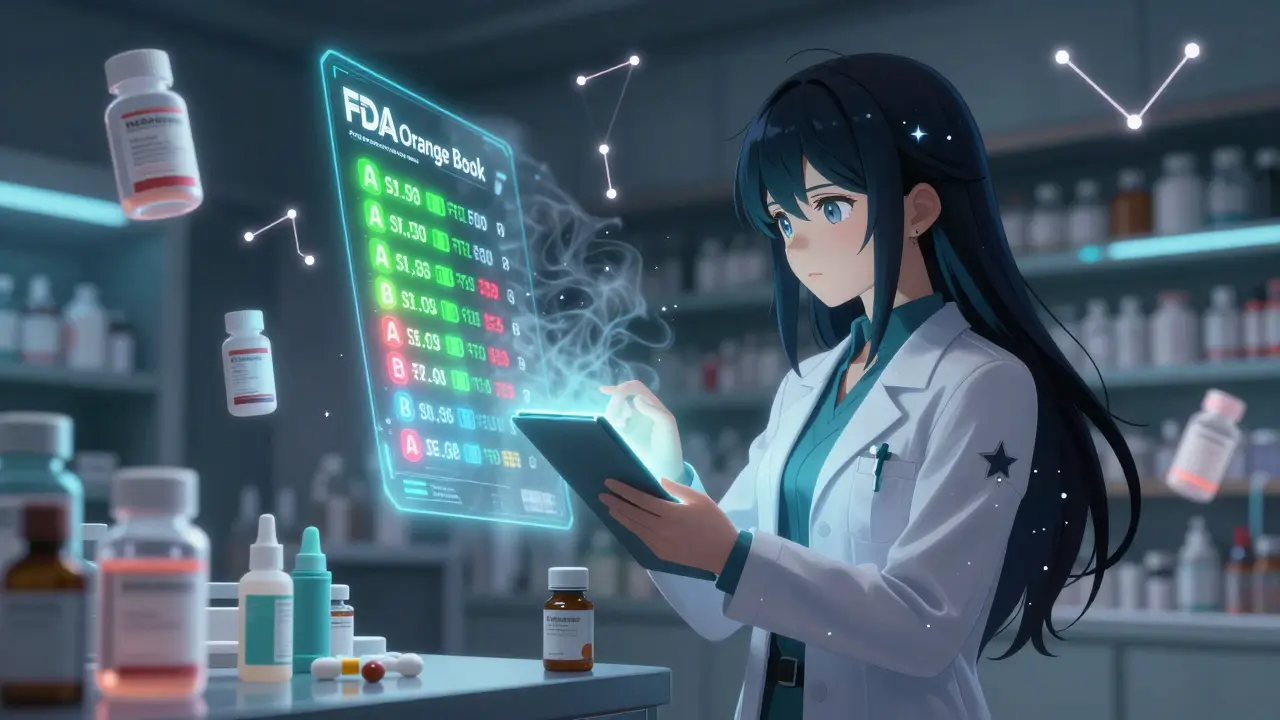
What This Means for You as a Patient
You don’t need to memorize TE codes. But you should know this: If your prescription is for a drug with an A code, you’re getting a safe, FDA-approved substitute. You’ll save money - often 80% less than the brand name. In 2022 alone, A-rated generics saved the U.S. healthcare system $298 billion. But if your doctor prescribes a drug with a B code - or if your pharmacist says they can’t substitute it - ask why. It’s not about the drug being unsafe. It’s about uncertainty. Sometimes, the brand-name version is the only one with proven performance. Other times, the generic just hasn’t been tested enough. You also have rights. In most states, you can ask for the brand-name drug even if a generic is available. You can ask your pharmacist to check the Orange Book. And you can ask your doctor to write “dispense as written” if you’ve had bad experiences switching generics.Don’t assume all generics are the same. Two generics of the same drug might have different TE codes. One might be interchangeable. The other might not. That’s why the Orange Book exists - to tell you which is which.
What’s Changing in 2025?
The Orange Book went fully digital in January 2023. It’s now accessible via API to electronic health records, pharmacy systems, and even insurance platforms. That means your pharmacist can check the TE code in real time as they fill your prescription. The FDA’s 2023 draft guidance on complex products signals a big shift: they’re moving away from one-size-fits-all bioequivalence standards. For inhalers, topical products, and injectables, they’re developing new testing models that better reflect real-world performance - not just blood levels. By 2028, experts predict over 93% of all generic prescriptions will be for A-rated drugs. That’s progress. But it also means the remaining B-rated products will become even more niche - often reserved for patients who need the exact formulation, not just any version of the drug.
What You Can Do Today
- If you’re prescribed a generic, ask your pharmacist: “Is this an A-rated product?” - If your insurance switches your drug and you feel different, tell your doctor. It might be a B-rated product. - Don’t panic if you’re told substitution isn’t allowed. It’s not a reflection of your health - it’s the system protecting you. - Keep your prescription labels. The TE code isn’t printed on the bottle, but the drug name and manufacturer are. You can look it up in the FDA’s Orange Book online.The system isn’t perfect. But it’s the most transparent, science-backed framework we have for making sure generics are safe, affordable, and reliable. And for millions of Americans, it’s the reason they can afford their medication at all.
Can a pharmacist substitute a generic drug without my permission?
It depends on your state’s laws and your doctor’s instructions. In most states, pharmacists can substitute a generic drug with an A-rated TE code unless the prescription says "dispense as written" or the patient refuses. Some states require patient consent before substitution. Always check your state’s pharmacy board rules.
Are all generic drugs the same as the brand name?
Only those with an A-rated TE code are considered therapeutically equivalent by the FDA. That means they have the same active ingredient, strength, dosage form, and bioequivalence. But inactive ingredients (like fillers or dyes) can differ. For most people, that doesn’t matter. But for those with allergies or sensitivities, it can. Always check with your pharmacist if you have concerns.
Why do some generics have B codes if they’re FDA-approved?
FDA approval means the drug is safe and effective. But therapeutic equivalence is a higher bar. A B code means the FDA hasn’t confirmed that the generic performs the same as the brand-name drug in real-world use - often because it’s a complex product like a cream, inhaler, or extended-release tablet. The science to prove equivalence is still developing for these types of drugs.
Can I request the brand-name drug even if a generic is available?
Yes. You have the right to ask for the brand-name drug, even if a generic is available and A-rated. Your pharmacist must fill that request. However, you may pay more out-of-pocket, and your insurance may not cover the full cost. Always ask your pharmacist about pricing differences.
Where can I check the TE code for my medication?
The FDA’s Orange Book is publicly available at accessdata.fda.gov/scripts/cder/ob/. You can search by drug name, manufacturer, or active ingredient. The TE code is listed next to each product. Your pharmacist can also look it up in real time using pharmacy software linked to the Orange Book.

Sara Stinnett
Let’s be real-this whole TE code system is a beautifully engineered illusion. The FDA pretends it’s all about science, but let’s not pretend Big Pharma didn’t lobby for every loophole in Hatch-Waxman. A-rated? Sure. But have you seen the inactive ingredients in some of these generics? Dyes that trigger migraines, fillers that cause bloating in people with IBS-none of that gets tested. The system doesn’t protect patients. It protects profit margins under the guise of ‘equivalence.’
And don’t get me started on the ‘Orange Book.’ It’s not orange. It’s not a book. It’s a labyrinthine digital graveyard of half-dead data, updated by interns who don’t understand pharmacokinetics. If you think your pharmacist is checking it in real time, you’re delusional. Most use third-party software that auto-populates based on outdated feeds. I’ve seen the same BX drug get flagged as AA three months later. No one’s auditing this.
And yet, we’re told to trust it. To be grateful for the 80% savings. But savings don’t mean safety. They mean ‘we’re not suing you yet.’
There’s a reason 68% of pharmacists hesitate on B-rated topicals. Because they’ve seen the rashes. The flare-ups. The patients who swear the new generic ‘doesn’t work like the old one.’ And the FDA? They call it ‘individual variability.’ I call it negligence dressed in Latin.
They’re investing $28.7 million to fix complex generics? Cute. That’s less than what Pfizer spends on a single Super Bowl ad. This isn’t a scientific initiative-it’s a PR stunt to keep the public from asking why insulin still costs $300 when the active ingredient is $2.
Don’t confuse transparency with integrity. The Orange Book is a mirror. It shows you exactly what the system wants you to see. And what it hides? That’s where the real medicine is.
linda permata sari
OMG I just cried reading this!! 🥹😭 I’m from Indonesia and we don’t have anything like the Orange Book here-generics are just… whatever the pharmacy has. My mom had a seizure once because they switched her epilepsy med without telling us. No codes. No warnings. Just a different pill. I wish every country had this level of transparency. This is justice in pill form. 💊✨
Brandon Boyd
Hey, listen-this is the kind of info that saves lives. You don’t need to be a pharmacist to get it. If your script says ‘generic’ and you feel off, ASK. Don’t wait. Don’t assume. Go to the FDA’s site. Type in your drug. Look at the code. That’s power. That’s control. And guess what? You earned it by being awake. Most people just swallow the pill and move on. You? You’re reading this. That’s the first step to taking charge of your health. Keep going. You’re doing better than you think.
Branden Temew
So the FDA gives us a two-letter code to decide if a pill is ‘good enough’ for our bodies, but they won’t tell us what’s in the filler that might be causing our anxiety? Fascinating. The system is so elegant-it’s like they took the worst parts of capitalism and wrapped it in a white lab coat. ‘Here’s your $3 generic. It’s bioequivalent. Probably.’ Meanwhile, the brand-name version has been quietly reformulated to avoid bioequivalence testing. Classic. I’m not mad. I’m just… disappointed in humanity’s ability to turn medicine into a board game.
Frank SSS
Look, I’m not here to argue about TE codes. I just want my blood pressure med to work. Last month they switched me from one generic to another-same name, different manufacturer-and I felt like I was walking through molasses for two weeks. My pharmacist didn’t even blink. Said ‘it’s an AA.’ Whatever. I’m just glad I found this post. Now I know to ask. That’s something, right?
Paul Huppert
Just checked my last prescription-AA code. Good to know. Thanks for explaining this so clearly.
Hanna Spittel
They’re hiding something. 🤫 I’ve seen the same generic from two different companies and one gives me panic attacks. The FDA says they’re the same. But why does my heart race with one and not the other? 🧠💥 Maybe the ‘inactive’ ingredients are secretly psychoactive? #OrangeBookLies #BigPharmaWatch
Deepika D
As someone who’s worked in community pharmacies across India and the U.S., I can tell you this: the TE code system is one of the most underappreciated public health tools on the planet. In countries without it, patients die from inconsistent generics-sometimes because of impurities, sometimes because of absorption issues. The Orange Book isn’t perfect, but it’s the only thing standing between a child with asthma and a counterfeit inhaler that doesn’t release the right dose. I’ve seen the chaos without it. The FDA’s initiative to reduce B codes? It’s slow, yes-but it’s moving in the right direction. And for patients in low-income communities, this isn’t bureaucracy. It’s survival. If you’re skeptical, go talk to a pharmacist in rural Mississippi or rural Bihar. They’ll tell you the same thing: ‘Better this than nothing.’
Also, if you’re a caregiver, keep that list of drug names and manufacturers. I’ve had patients come in crying because their diabetes med changed and they didn’t know why. A simple note saved a man from a hypoglycemic episode last week. You don’t need to be an expert. You just need to be observant. And that’s already more than most people do.
And yes, the system is flawed. But it’s the only one we have that’s transparent, data-driven, and accessible to the public. That’s rare. Don’t throw it out because it’s not perfect. Push for better. But don’t dismiss it.
Also-your pharmacist isn’t just a pill dispenser. They’re your last line of defense. Ask them to check the code. Ask them why they’re substituting. Ask them if they’ve seen reactions to that brand before. They’ll appreciate it. And you’ll sleep better.
This post? It’s a gift. Share it. Print it. Tape it to your fridge. Someone’s life depends on someone reading it.
Bennett Ryynanen
Yeah, yeah, TE codes, Orange Book, all that jazz. But here’s the real issue: insurance companies force substitutions. They don’t care about AA or BX. They care about cost. And if you’re on Medicaid or some crappy HMO, you don’t get to pick. Your doctor writes ‘dispense as written’? Good luck getting that honored. I’ve had patients get switched mid-chemo because the insurer found a cheaper generic with a B code. And the pharmacy? They just shrug. ‘It’s approved.’ No, it’s not approved for YOU. That’s the problem. The system’s rigged. And the FDA? They’re just the middleman with a clipboard.