
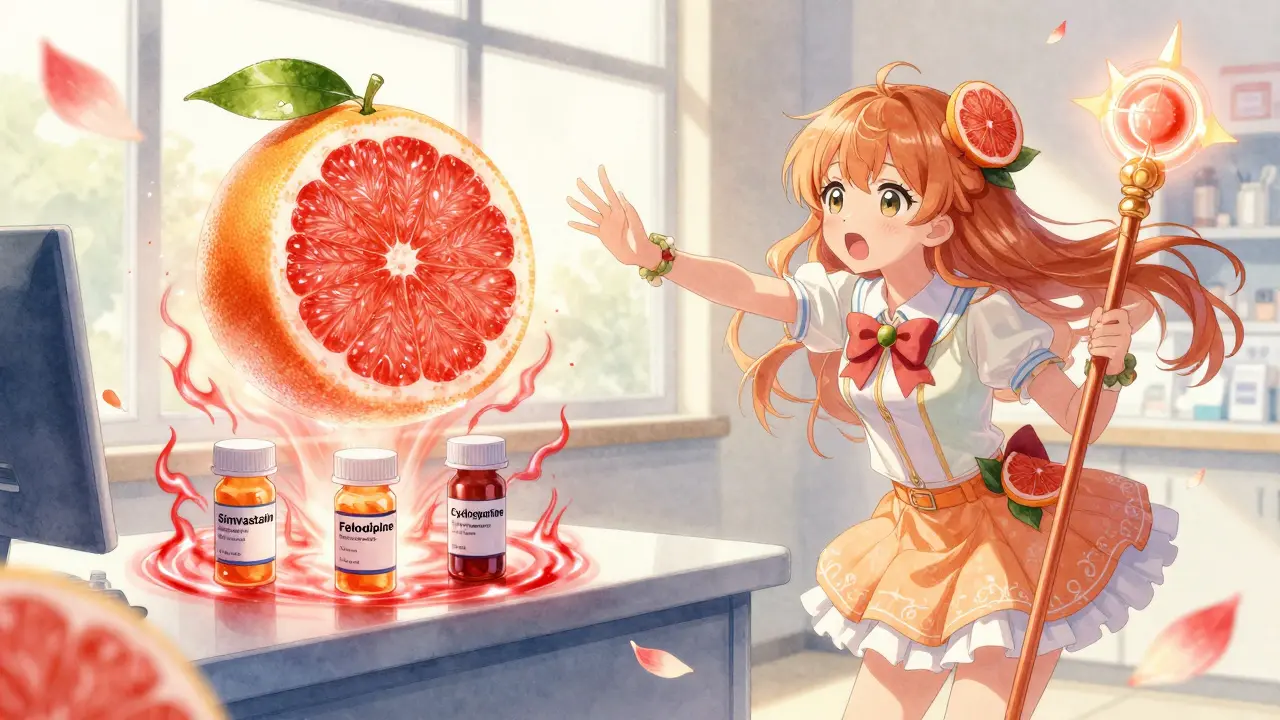
One small glass of grapefruit juice can turn a safe medication into a dangerous one. It’s not a myth. It’s not a rumor. It’s science - and it’s happening right now to people who think they’re doing something healthy by drinking their morning juice. If you’re taking any kind of prescription medicine, especially if you’re over 45, you need to know which ones are affected by grapefruit - and why even a sip can cause serious harm.
How Grapefruit Changes Your Medication
Grapefruit doesn’t just taste sour. It contains chemicals called furanocoumarins, mainly bergamottin and 6',7'-dihydroxybergamottin. These compounds shut down an enzyme in your gut called CYP3A4. This enzyme normally breaks down certain drugs before they enter your bloodstream. When it’s blocked, the drug doesn’t get broken down. Instead, it floods into your system - sometimes three, five, even ten times more than it should. This isn’t a temporary effect. Once the enzyme is turned off, it stays off for up to 72 hours. That means even if you take your medicine at night and drink grapefruit juice in the morning, you’re still at risk. There’s no safe window. No "wait a few hours" trick. The only way to avoid it is to stop eating or drinking grapefruit entirely while on these meds.Medications That Can Become Dangerous
Not every drug is affected. But the ones that are? They’re often taken long-term by older adults - people who are already at higher risk for side effects. Statins - the cholesterol-lowering drugs - are among the most common offenders. Simvastatin (Zocor) is the worst. Just 200 milliliters (about 7 ounces) of grapefruit juice daily for three days can triple your blood levels of simvastatin. That dramatically raises your chance of rhabdomyolysis - a condition where muscle tissue breaks down, releasing toxins that can wreck your kidneys. Lovastatin (Mevacor) behaves the same way. Atorvastatin (Lipitor) sees an 80% spike in levels. But pravastatin (Pravachol) and rosuvastatin (Crestor)? They’re safe. They use different pathways in the body and aren’t broken down by CYP3A4. Calcium channel blockers, used for high blood pressure and chest pain, are another big group. Felodipine (Plendil) can see blood levels jump by 355%. Nifedipine (Procardia) increases by 274%. Amlodipine (Norvasc) can rise by 150%. These spikes can cause your blood pressure to drop too low, leading to dizziness, fainting, or even heart problems. Immunosuppressants are where things get life-threatening. People who’ve had organ transplants take these drugs to stop their body from rejecting the new organ. Cyclosporine (Sandimmune) levels can rise 50-60%. Tacrolimus (Prograf) can surge by 300-500%. Sirolimus (Rapamune)? Up to 1100%. Too much of these drugs can cause kidney failure, severe infections, or even death.Other Fruits That Act Like Grapefruit
Grapefruit isn’t alone. Seville oranges - the kind used in traditional marmalade - contain the same chemicals. Pomelos, a large citrus fruit related to grapefruit, are just as risky. Even limes, especially the Persian variety, have been shown to cause similar effects in lab studies. If a citrus fruit tastes bitter or has a thick rind, it’s more likely to be dangerous. Pomegranate? One case report suggests it might act like grapefruit too, though the evidence isn’t as strong. But until we know for sure, it’s safer to avoid it if you’re on a high-risk medication.
Why This Matters More Than Ever
In 2021, over half of Americans aged 65 and older were taking five or more prescription drugs. Many of them also drink grapefruit juice because they believe it’s good for heart health. It’s a perfect storm. The FDA estimates grapefruit interactions cause about 10,000 adverse events in the U.S. every year. That’s not a small number. It’s not a footnote. It’s a public health issue. Hospitals now have alerts built into their electronic systems. Pharmacists are trained to ask patients about grapefruit during medication reviews. And yet, many people still don’t know.What You Should Do
If you’re on medication, here’s what to do:- Check your label. If your prescription bottle says "avoid grapefruit," take it seriously.
- Ask your pharmacist. They’re the ones who see your full list of meds. They can tell you if grapefruit is a problem with any of them.
- Ask your doctor. If you love grapefruit, ask if there’s a safer alternative. For example, if you’re on simvastatin, switching to rosuvastatin might be an option. If you’re on amlodipine, diltiazem might work instead.
- Don’t assume "a little" is okay. Even one glass can cause a reaction. And the effect lasts days.

What If You’ve Already Had a Glass?
If you accidentally drank grapefruit juice while on one of these drugs, don’t panic - but don’t ignore it either. Watch for signs like unexplained muscle pain, weakness, dark urine, dizziness, or rapid heartbeat. Call your doctor or pharmacist right away. They can check your drug levels or adjust your dose if needed.Bottom Line
Grapefruit isn’t evil. It’s full of vitamin C and antioxidants. But for people on certain medications, it’s a hidden danger. The interaction isn’t rare. It’s predictable. And it’s deadly serious. The fix is simple: if your medicine is on the list, skip the grapefruit. There are plenty of other fruits that won’t interfere - apples, oranges (not Seville), berries, bananas. You don’t have to give up healthy eating. You just need to know which foods play nice with your meds - and which ones don’t.Can I drink grapefruit juice if I take my medication at a different time of day?
No. The chemicals in grapefruit permanently disable the CYP3A4 enzyme in your gut for up to 72 hours. Even if you take your pill at night and drink juice in the morning, the enzyme is still blocked. Timing doesn’t matter - only complete avoidance does.
Are all citrus fruits dangerous with medications?
No. Regular oranges and tangerines are safe. But Seville oranges (used in marmalade), pomelos, and limes are not. These contain the same furanocoumarins as grapefruit. Stick to sweet oranges, apples, berries, or pears if you’re unsure.
Why do some statins interact with grapefruit and others don’t?
It depends on how the drug is processed. Simvastatin, lovastatin, and atorvastatin rely on the CYP3A4 enzyme to break them down. Pravastatin and rosuvastatin use different pathways - so grapefruit doesn’t affect them. Your doctor can switch you to a safer statin if needed.
Is grapefruit juice worse than eating the fruit?
It’s about the same. Both contain the same furanocoumarins. Juice might have slightly higher concentrations because it’s more concentrated, but eating the whole fruit carries the same risk. Neither is safe if you’re on a high-risk medication.
What should I do if I’m on multiple medications?
Ask your pharmacist to run a full interaction check. Many community pharmacies now do this automatically during medication reviews. Bring a list of everything you take - including supplements and over-the-counter drugs. Grapefruit can interact with more than just prescriptions.
Can I switch to a different medication to keep drinking grapefruit juice?
Yes, for many drugs. If you’re on simvastatin, ask about rosuvastatin or pravastatin. If you’re on felodipine, diltiazem or verapamil may be alternatives. For immunosuppressants, your doctor may consider lower doses or different drugs altogether. Never switch on your own - but do ask if alternatives exist.
Are there any new grapefruit varieties that are safe?
Researchers are testing grapefruit with 85-90% less furanocoumarin through special farming methods. Early results look promising, but these aren’t available to the public yet. Until they are, assume all grapefruit is risky.
How common are grapefruit-drug interactions?
The FDA estimates 10,000 adverse events per year in the U.S. alone. Over 85 medications are known to interact, and 43 of those can cause life-threatening reactions. It’s one of the most common and dangerous food-drug interactions out there.
Should I stop eating grapefruit if I’m healthy and not on any meds?
No. Grapefruit is fine for people not taking medications that interact with it. The problem isn’t the fruit - it’s the combination with certain drugs. If you’re not on any prescriptions, enjoy it. Just be aware if you start a new medication later.
Do over-the-counter drugs or supplements interact with grapefruit?
Yes. Some antihistamines, sedatives like midazolam, and even certain herbal supplements like St. John’s wort can be affected. Always check with your pharmacist when starting any new product, even if it’s sold without a prescription.
When it comes to grapefruit and medicine, ignorance isn’t bliss - it’s risky. A simple question to your pharmacist could prevent a hospital visit. Don’t wait for a side effect to happen. Ask now.




Aadil Munshi
Look, I get it - grapefruit is basically nature’s way of saying "I hate your liver" when you’re on meds. But let’s be real, if you’re taking statins and still chugging grapefruit juice because "it’s healthy," you’re not being proactive, you’re being a walking clinical trial. CYP3A4 doesn’t care about your wellness blog. It just shuts down. And then your muscles turn to soup. No cap.
Also, why do people think timing saves them? Like, if I poison my body at 8 AM, and take my pill at 11 PM, suddenly it’s fine? No. The enzyme’s dead for three days. It’s not a Wi-Fi router you can reboot. It’s biology. Hard stop.
Frank Drewery
This is such an important post. I had no idea even one glass could do this. My dad’s on a statin and he loves his morning grapefruit - I’m sending him this right now. Thanks for breaking it down so clearly. Sometimes the simplest things are the most dangerous, you know?
Also, glad you mentioned the safe statins. That’s the kind of practical info that actually saves lives.
Danielle Stewart
Hi there - I’m a pharmacist, and I see this exact scenario every single week. People come in saying, "But I only drink it once a week!" or "I took my pill last night!" - and I have to gently explain that grapefruit doesn’t play by the rules of common sense.
Here’s the thing: if your med bottle says "avoid grapefruit," it’s not a suggestion. It’s a warning label, like on a bottle of bleach. And yes, switching to rosuvastatin or pravastatin is often an easy fix. Ask your doc - you deserve to eat healthy without risking your kidneys.
Also, if you’re on immunosuppressants? Please, please, please don’t gamble with this. One sip can be the difference between life and ICU.
mary lizardo
It is, without question, a remarkable oversight in public health education that so many individuals remain unaware of the pharmacokinetic implications of furanocoumarin-containing citrus fruits. The fact that the FDA estimates 10,000 adverse events annually is not merely alarming - it is a systemic failure of prescriber diligence and patient literacy.
Furthermore, the casual dismissal of this risk as "just a juice" reflects a broader cultural disregard for biochemical precision. One must wonder: if we cannot communicate the danger of a single 200-milliliter serving, how can we expect the public to comprehend complex polypharmacy regimens?
And while we are at it, let us not conflate pomelo with grapefruit as if they are interchangeable. Taxonomically, they are distinct species. The risk, however, is identical. Precision matters.
jessica .
Okay but… what if this is all a big pharma scam? I mean, why would they make grapefruit dangerous? To sell more pills? They want you to switch to $300-a-month drugs instead of a $2 fruit. They even made the juice so you can’t avoid it - it’s in everything. And why don’t they just change the fruit? They could breed out the toxins. They’re not doing it because they profit off your ignorance.
Also, I heard the FDA is funded by drug companies. So yeah. Don’t trust the system. Drink the juice. Fight the power. 🍊✊
Ryan van Leent
Man I just had a glass yesterday and I’m on amlodipine and I feel fine so maybe it’s not that bad
Also why do people care so much about grapefruit anyway I mean it’s just a fruit right
My grandma drank it her whole life and never had a problem so what’s the big deal
Also I think this whole thing is overblown I mean if it was really dangerous wouldn’t the FDA ban it already
Just saying
Sajith Shams
Let me break this down for you in terms you can understand - if your medication is metabolized by CYP3A4, grapefruit is a silent assassin. It doesn’t just increase drug levels - it hijacks your entire metabolic pathway. You think you’re being smart with your juice? You’re just handing your liver a suicide note.
And don’t get me started on people who say "I only drink it on weekends." That’s not how biochemistry works. The enzyme doesn’t take weekends off. It dies. And it doesn’t come back for 72 hours. So your "weekend juice" is actually a daily toxin.
Pravastatin and rosuvastatin? Good choices. Stick to those. Stop pretending you’re too cool for science.
Adrienne Dagg
OMG I just realized I’ve been drinking grapefruit juice with my blood pressure med 😱 I’m so mad at myself but also so grateful for this post!!
Switching to apples now 🍎💛 I love you, science. You saved my life.
P.S. If you’re on anything and drink grapefruit - tell your friends. This is the kind of info that needs to go viral. 🙏✨
Erica Vest
There is a critical nuance often missed: the interaction is dose-dependent and enzyme-specific, not universally catastrophic. While grapefruit juice significantly elevates plasma concentrations of CYP3A4-metabolized drugs, the clinical significance varies by drug, dosage, and individual metabolic capacity.
For example, a single 200 mL serving of juice may elevate simvastatin by 300%, but in a healthy 55-year-old with no renal impairment, this may not reach the threshold for rhabdomyolysis. However, in elderly patients with polypharmacy or renal insufficiency, even modest elevations can be dangerous.
Therefore, blanket avoidance is prudent - but not all patients are equally at risk. Pharmacogenomics and therapeutic drug monitoring can offer personalized guidance. Always consult your pharmacist - they have access to databases that predict interaction severity.
Chris Davidson
People don’t read labels anymore. That’s the real problem. If your bottle says don’t mix with grapefruit then don’t mix with grapefruit. Simple. No excuses. No exceptions. You want to be healthy? Then be responsible. This isn’t rocket science. It’s basic pharmacy 101.
And if you’re old enough to be on five meds you should know better. Stop blaming the fruit. Start blaming yourself.
Glen Arreglo
I’m from India and we’ve been drinking citrus juices for generations without knowing about CYP3A4. But here’s the thing - we also don’t take as many synthetic drugs. When people rely on traditional medicine or take fewer prescriptions, the risk drops. This isn’t just about grapefruit - it’s about overmedication in Western cultures.
Maybe we should ask: why are we on so many drugs in the first place? And why is juice the villain instead of the system?
That said - if you’re on one of these meds, skip the grapefruit. I’m not arguing with the science. I’m just asking us to look deeper.