

Tramadol Medication Interaction Checker
Medication Selection
Select all medications you are currently taking
Risk Assessment
Based on your selections, here's your risk level
Most people think of opioids as painkillers that work one way: by binding to opioid receptors in the brain. But tramadol doesn’t play by those rules. It’s an opioid, yes-but it also messes with serotonin in your brain. And that’s where things get dangerous.
Tramadol was designed to be a safer alternative to drugs like morphine or oxycodone. It’s weaker on opioid receptors, so it was thought to have less risk of addiction. But what made it seem safer turned out to be its biggest hidden danger. Unlike other opioids, tramadol blocks the reuptake of serotonin, a chemical that helps regulate mood, sleep, and muscle control. When serotonin builds up too much, your body can go into overdrive. That’s serotonin syndrome-a rare but life-threatening reaction.
How Tramadol Is Unlike Other Opioids
Take morphine, fentanyl, or hydrocodone. They bind tightly to opioid receptors and do little else. Tramadol? It’s a two-for-one. It binds weakly to opioid receptors (about 6,000 times weaker than morphine) but also stops serotonin from being cleared out of brain spaces. The (+)-enantiomer of tramadol is the main culprit here. It’s like a clog in the serotonin drain. The more you take, the more serotonin piles up.
And it doesn’t stop there. Tramadol gets broken down in the liver by an enzyme called CYP2D6 into a more powerful opioid called M1. But if you’re a poor metabolizer-about 7% of white people-you don’t make enough M1. That means more of the original tramadol stays in your system, and with it, more serotonin disruption. This isn’t theoretical. A 2013 study in the Journal of Clinical Psychiatry found that tramadol caused serotonin syndrome in 14.7% of people taking it with an SSRI. Codeine? 0.8%. Hydrocodone? 1.2%.
When Even a Normal Dose Can Trigger It
You might think you’re safe if you stick to the recommended dose: 50-100 mg every 4-6 hours. But that’s not always true.
A 63-year-old woman in a 2009 case report took exactly 100 mg of tramadol twice a day-no other drugs, no overdose. Within hours, she developed fever, sweating, confusion, and muscle stiffness. She didn’t have a history of depression. She wasn’t on antidepressants. She was just taking tramadol. Symptoms cleared up in 24 hours after stopping it. This case wasn’t an outlier. Since 2008, at least 47 documented cases of serotonin syndrome from tramadol alone have been reported in medical journals.
That’s unheard of with other opioids. You won’t find a single credible case of serotonin syndrome from morphine or oxycodone taken alone at therapeutic doses. Tramadol is the exception. It’s the only opioid where even a normal dose, with no other drugs, can cause this reaction.
The Perfect Storm: Tramadol + Antidepressants
The real danger comes when tramadol meets antidepressants. SSRIs like fluoxetine (Prozac), sertraline (Zoloft), or SNRIs like venlafaxine (Effexor) also increase serotonin. Combine them with tramadol, and you’re doubling down on the same mechanism.
A 2015 study of 187,000 Medicare patients found that taking tramadol with an SSRI increased the risk of serotonin syndrome by 3.6 times compared to taking the antidepressant alone. That’s not a small bump. That’s a red flag.
Even worse, some SSRIs block the CYP2D6 enzyme. That means they stop your body from breaking down tramadol properly. The result? You end up with more tramadol-and more serotonin-than you were supposed to. It’s a therapeutic overdose, even if you’re taking your pills exactly as prescribed.
One Reddit user described it this way: "I didn’t realize my 50 mg tramadol was interacting with my Lexapro until I ended up in the ER with a 104°F fever." That’s not a rare story. Emergency departments see these cases regularly.

What Serotonin Syndrome Actually Looks Like
It’s not just "feeling weird." Serotonin syndrome has clear signs, and they come on fast-usually within hours of a dose change.
- Clonus: Involuntary muscle spasms. You might notice your foot twitching uncontrollably when you point your toes.
- Hyperreflexia: Your knee jerk reflex is way too strong.
- Diaphoresis: Sweating so hard you soak your clothes.
- Hyperthermia: Body temperature over 38°C (100.4°F). In severe cases, it hits 41°C (106°F).
- Mental status changes: Confusion, agitation, hallucinations, or even coma.
- Muscle rigidity: Like a statue. You can’t relax your arms or legs.
The Hunter Serotonin Toxicity Criteria is the gold standard for diagnosis. You don’t need all of these. Just one of these combinations is enough:
- Spontaneous clonus
- Inducible clonus + agitation or sweating
- Ocular clonus + agitation or sweating
- Tremor + hyperreflexia
- Hypertonia + fever over 38°C + clonus
Emergency rooms use this checklist because it’s 84% accurate. If you have even one of these, and you’re on tramadol, it’s not a guess-it’s a diagnosis.
Who’s at Highest Risk?
It’s not just about what you’re taking. It’s who you are.
- Older adults: The American Geriatrics Society lists tramadol as potentially inappropriate for people over 65. Why? Their liver and kidneys don’t clear drugs as well. Plus, they’re more likely to be on antidepressants. Risk is 2.7 times higher than with other painkillers.
- People with depression or bipolar disorder: Tramadol can trigger hypomania or worsen mood swings. One case involved a woman with bipolar II who went into serotonin syndrome just 48 hours after starting tramadol for fibromyalgia.
- Poor CYP2D6 metabolizers: 7-10% of Caucasians, 1-2% of Asians. If you’re one of them, your body can’t break down tramadol. That means more serotonin buildup.
- People on multiple serotonergic drugs: Triptans (for migraines), certain antibiotics (like linezolid), dextromethorphan (in cough syrup), and even St. John’s Wort can push you over the edge.
What to Do If You’re on Tramadol
If you’re currently taking tramadol, here’s what to check:
- Are you taking any antidepressant? (SSRI, SNRI, MAOI)
- Are you taking migraine meds like sumatriptan or rizatriptan?
- Are you using over-the-counter cough medicine with dextromethorphan?
- Have you noticed new muscle twitching, sweating, or confusion?
If you answered yes to any of those, talk to your doctor before your next refill. Don’t wait for symptoms to get worse.
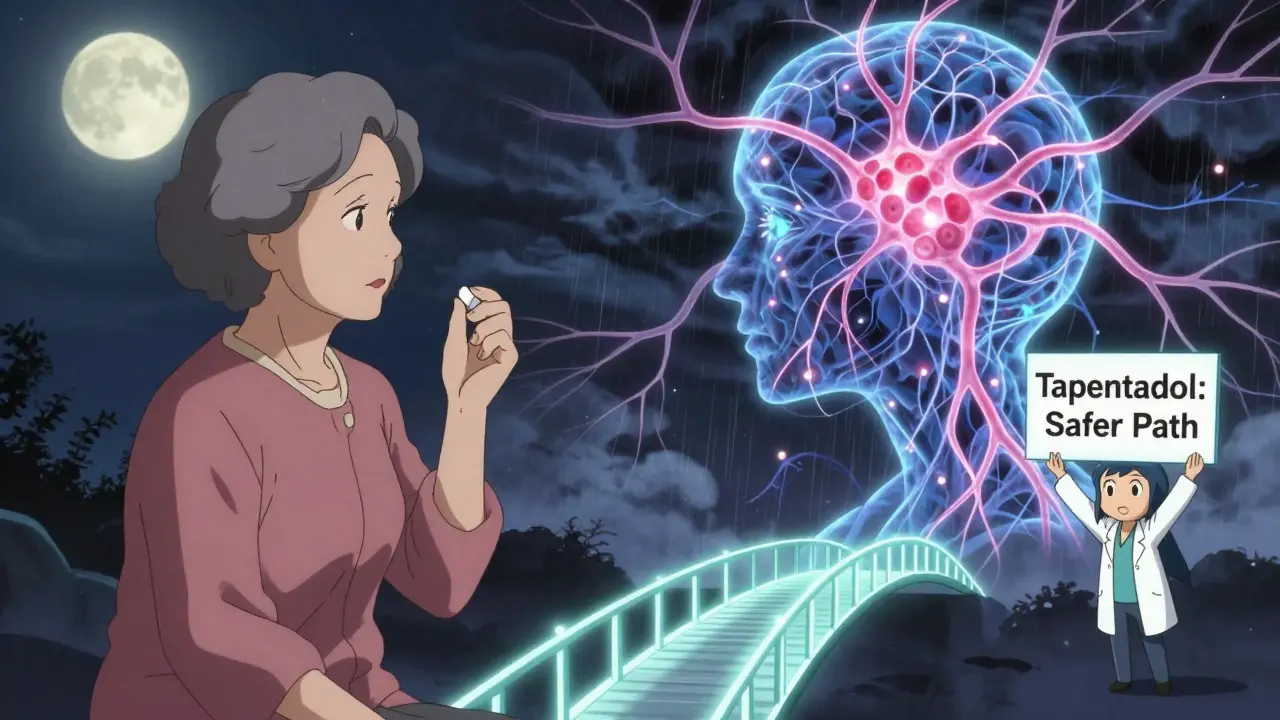
For people who need pain relief but are at risk, alternatives exist. Tapentadol is a newer opioid that works like tramadol but doesn’t affect serotonin. A 2023 NIH study found tapentadol caused serotonin syndrome in just 0.4% of patients-half the rate of tramadol. It’s not perfect, but it’s safer for people on antidepressants.
What Happens If You Get It?
Time matters. The sooner you stop tramadol and get treatment, the better.
First: Stop taking tramadol immediately. No exceptions.
Second: Go to the ER. This isn’t something you can manage at home. Mild cases can be treated with benzodiazepines (like lorazepam) to calm the nervous system. Severe cases need ICU care.
Third: Cyproheptadine. This is an antihistamine-but it’s also a serotonin blocker. Doctors use it as the first-line antidote. A 12 mg dose, often repeated, can reverse symptoms within hours.
Without treatment, serotonin syndrome can lead to seizures, kidney failure, or death. But with quick action? Mortality drops from 22% to under 0.5%.
The Bigger Picture: Is Tramadol Still Used?
Yes-but less than before. In 2011, the FDA added a black box warning about seizures at doses over 400 mg/day. In 2014, it was reclassified from Schedule IV to Schedule II because of abuse potential. Prescriptions dropped 9.3% after that.
Now, guidelines are tightening further. UpToDate, the clinical decision tool used by 80% of U.S. doctors, says: "Tramadol should be avoided in patients taking any serotonergic medication." The CDC says it has "unique serotonergic risks not shared by other opioids." The European Medicines Agency is considering restricting it in patients with psychiatric conditions by 2025.
Still, it’s not going away. In 2022, there were 39.4 million tramadol prescriptions in the U.S. It’s cheap-$15 for 30 tablets-and effective for nerve pain. For some people, it’s the only thing that works. But for many others, the risks outweigh the benefits.
The future might hold safer versions. Researchers are testing a modified form of tramadol called M1-tramadol that keeps the pain relief but cuts out the serotonin effect. Phase II trials are underway. Until then, caution is the rule.
Bottom Line
Tramadol isn’t just another opioid. It’s a hidden risk in plain sight. If you’re on antidepressants, have a history of mood disorders, or are over 65, it’s not worth the gamble. Even if you’re not on other meds, you could still be at risk if your body processes it slowly. The symptoms come fast, and they’re easy to miss-until it’s too late.
If you’re taking tramadol and feel strange-twitchy, sweaty, confused, or too warm-stop it and get help. There are safer options. You don’t have to risk your life for pain relief.



APRIL HARRINGTON
just took tramadol for my back and now i’m sweating like i ran a marathon and my leg is twitching like it’s got a mind of its own
thought it was just anxiety but now i’m scared to move
why does no one warn you about this
my dr said it was safe
they don’t even ask if i’m on antidepressants
how is this still prescribed like it’s ibuprofen
im going to the er in 5
Janelle Pearl
thank you for posting this. i’ve been on sertraline for 8 years and was prescribed tramadol for a herniated disc last year.
i didn’t connect the dots until i started having tremors and night sweats.
my doctor said "it’s rare" but i looked it up and found 47 documented cases of it happening with just tramadol alone.
switched to tapentadol last month and i feel like a new person.
no more twitching. no more confusion.
if you’re on any antidepressant and taking tramadol-please, talk to your doctor before your next refill.
it’s not worth the gamble.
Leon Hallal
this is why you dont take drugs
Peter Kovac
While the post presents a compelling clinical narrative, it lacks critical contextualization regarding population-level risk.
With 39.4 million tramadol prescriptions in the U.S. in 2022, the absolute incidence of serotonin syndrome remains exceedingly low.
Correlation does not imply causation, and the majority of cases involve polypharmacy or metabolic anomalies.
The data cited from the 2013 JCP study must be interpreted with caution due to selection bias.
Furthermore, the Hunter Criteria, while useful, lacks specificity in outpatient settings.
Dismissing tramadol as uniquely dangerous ignores its utility in neuropathic pain, particularly in patients with opioid tolerance.
Pharmacovigilance should not devolve into fearmongering.
Judith Manzano
i had no idea tramadol affected serotonin like that
my mom’s on lexapro and took tramadol for her arthritis last winter
she said she felt "off" but never mentioned the sweating or muscle tightness
now i’m going to ask her doctor if she can switch to something safer
thank you for making this so clear
you’re right-this isn’t just another opioid
it’s like a silent landmine
if you’re on meds for mood, this could be hiding in plain sight
please share this with anyone you know who’s on pain meds
rafeq khlo
you people are so weak you cant handle a little pain without chemical crutches
Philip Mattawashish
let me guess-you're one of those people who think biology is a suggestion
your body doesn't need serotonin boosters
it needs discipline
if you're taking antidepressants you're already surrendering to weakness
and now you want a painkiller that's "safe"
there is no safe
only consequences
the fact that you're surprised by this means you never read the damn label
stop blaming the drug
blame the mindset that thinks a pill can fix everything
Tom Sanders
so like… if i’m on zoloft and i take tramadol for my sciatica
and i start sweating and my foot twitches
and i’m like "huh weird"
and then i go to sleep
and wake up with a 103 fever
is that a thing
or am i just overthinking
Stephen Rudd
you’re all acting like this is some new revelation
tried tramadol in 2016
got serotonin syndrome
woke up in the hospital with a catheter and a nurse yelling at me
no one warned me
my doctor said "it’s fine"
my pharmacist didn’t say a thing
the system is broken
and you’re all just screaming into the void
they’ll keep prescribing it
because it’s cheap
because it’s easy
because they don’t care
you think this post changes anything
it doesn’t