
When you pick up a generic pill at the pharmacy, you expect it to work just like the brand-name version. You don’t want to wonder if it’s weaker, less safe, or made in a facility with dirty equipment. The truth is, generic drugs are held to the same strict standards as brand-name drugs - and the FDA has a whole system built to make sure they are.
How Generic Drugs Get Approved Without Repeating Clinical Trials
Generic drugs don’t need to run new clinical trials to prove they work. That’s because the original brand-name drug already went through years of testing. Instead, manufacturers submit an Abbreviated New Drug Application, or ANDA. This application doesn’t re-prove safety or effectiveness. It proves one thing: bioequivalence.
Bioequivalence means the generic drug releases the same amount of active ingredient into your bloodstream at the same rate as the brand-name version. The FDA requires that the generic’s absorption falls within 90-110% of the original. That’s not a guess - it’s measured through controlled studies in healthy volunteers. If it doesn’t meet this range, the application gets rejected.
It’s not just about the active ingredient. The generic must also match the brand in strength, dosage form, route of administration, and labeling. Even the inactive ingredients - like fillers or coatings - must be safe and not interfere with how the drug works. The FDA reviews every detail before approval.
The Hidden Gatekeeper: Manufacturing Inspections
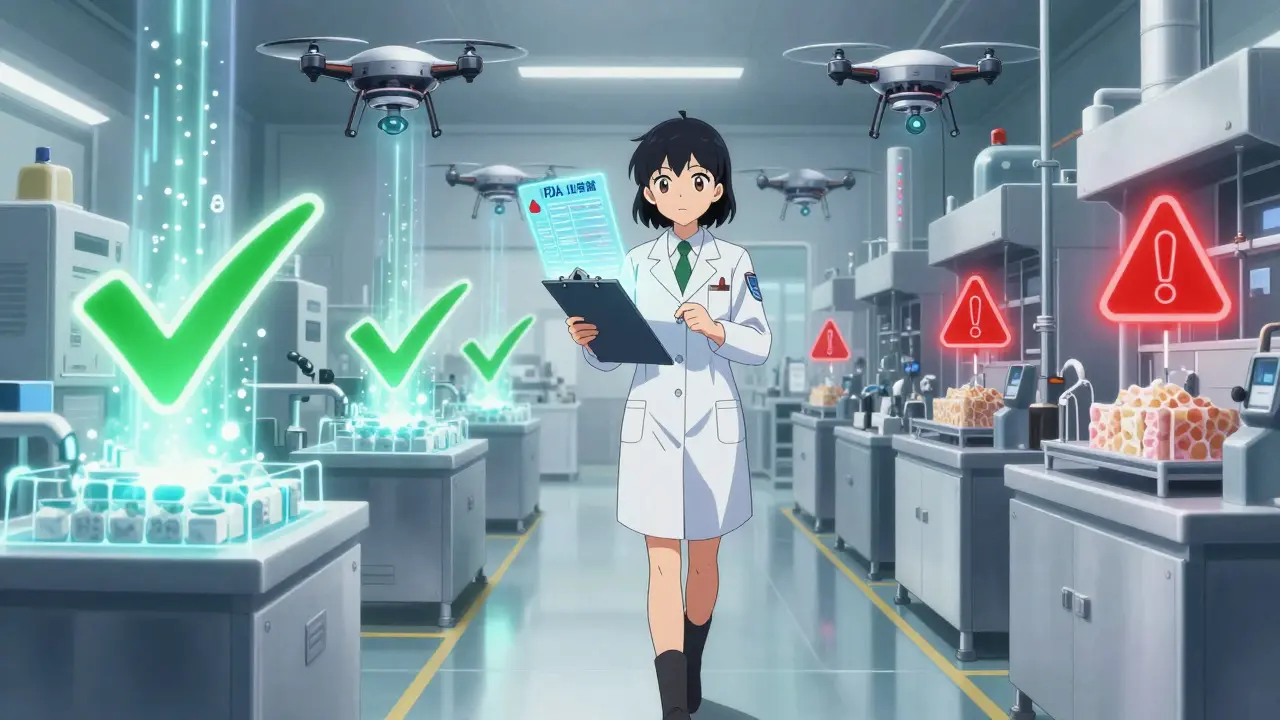
Approval isn’t just paperwork. Before a single pill is made, the FDA inspects the factory. This is where many applications stall or fail. The FDA checks for compliance with Current Good Manufacturing Practices, or cGMP. These aren’t suggestions. They’re legal requirements.
cGMP means every step of production is controlled: how raw materials are stored, how machines are cleaned between batches, how workers are trained, how environmental conditions like humidity and temperature are monitored. The FDA doesn’t just look at documents - they walk through the facility. They check if equipment is calibrated, if records are accurate, if there’s contamination risk.
Between 2011 and 2013, the FDA increased pre-approval inspections of generic drug plants by 60%. Today, they inspect both U.S. and foreign facilities. In 2021, the FDA completed 1,082 inspections worldwide. By 2025, they plan to hit 1,500 - mostly overseas, since more than 80% of active pharmaceutical ingredients (APIs) come from outside the U.S.
Foreign inspections used to lag behind domestic ones. Now, thanks to GDUFA (Generic Drug User Fee Amendments), the FDA has more funding and staff to close that gap. They use a risk-based system: factories with past violations, complex products, or poor compliance history get inspected more often.
Quality Control: From Raw Materials to Final Pills
Generic drug manufacturers must have three layers of quality control:
- Raw material control: Every batch of active ingredient is tested for purity, potency, and contaminants before it’s even mixed. The FDA requires full traceability - from the supplier’s lab to the final bottle.
- Process controls: Every step in production has written procedures. Temperature during mixing, pressure during compression, drying time - all are monitored and recorded. If a parameter goes outside the limit, the batch is discarded.
- Final product testing: Each batch is tested for dissolution (how quickly it breaks down), uniformity (are all pills the same strength?), and stability (does it stay effective over time?). These tests use validated methods that meet international standards.
The FDA’s Office of Pharmaceutical Quality (OPQ) reviews impurities - unwanted substances that can form during manufacturing. Even tiny amounts can be dangerous. If a generic drug has an impurity not found in the brand-name version, or if it exceeds safety thresholds, the FDA will block approval.
Post-Market Surveillance: Watching After Approval
Approval isn’t the end. The FDA keeps watching. Every drug - generic or brand - is tracked after it hits the market. The agency collects about 1.3 million adverse event reports each year through MedWatch, the system where patients and doctors report side effects.
When a spike in reports comes in for a specific generic drug, the FDA’s Division of Clinical Safety and Surveillance digs in. They compare data across brands and generics. Are people having more heart palpitations with this version? Is there a pattern of confusion in elderly patients? They use data analytics to spot trends others miss.
If a safety issue is confirmed, the FDA can take action: issue a warning letter, require updated labeling, or even push for a voluntary recall. In 2021, the FDA took regulatory action on over 150 generic drugs based on post-market findings.
It’s not just about reactions. The FDA also monitors for medication errors - like when a patient takes the wrong generic because the pill looks different. They work with manufacturers to standardize pill appearance where possible, without changing the drug’s function.
Why the System Works - and Where It Still Struggles
The numbers speak for themselves. Generic drugs make up 90% of prescriptions in the U.S. but cost only 23% of total drug spending. In 2022, they saved the healthcare system $313 billion. That’s only possible because the system works.
But it’s not perfect. In 2019, FDA inspections found quality issues in 15% of foreign generic drug plants - more than double the 8% rate for U.S. facilities. Some plants were found using substandard raw materials, falsifying records, or skipping critical tests. The FDA has responded by expanding its overseas presence and partnering with foreign regulators.
GDUFA III, launched in 2022, is the biggest push yet. It allocates $1.1 billion through 2027 to modernize inspections, improve data sharing, and speed up reviews. Since 2012, review times have dropped from 30 months to under 10 months for standard applications. That’s a 75% improvement.
Even so, challenges remain. Complex generics - like inhalers, injectables, or topical creams - are harder to copy. The FDA has launched special initiatives to develop better testing methods for these. And with global supply chains stretching across continents, tracking every component is getting harder.
What You Can Do as a Patient
You don’t need to be an expert to stay safe. If you notice a change in how your generic drug works - like new side effects, less relief, or different side effects - tell your doctor. Report it to MedWatch. You don’t need to know the brand name. Just describe the pill, the dose, and what happened.
Also, don’t assume all generics are identical. Different manufacturers might use different inactive ingredients. If you have allergies or sensitivities (like to lactose or dyes), ask your pharmacist which version you’re getting.
And remember: the FDA doesn’t approve a generic because it’s cheap. They approve it because it’s proven to be just as safe and effective as the original. That’s the standard - and it’s non-negotiable.
Are generic drugs as safe as brand-name drugs?
Yes. The FDA requires generic drugs to meet the same standards for quality, strength, purity, and performance as brand-name drugs. They must be bioequivalent - meaning they deliver the same amount of active ingredient into your bloodstream at the same rate. The only differences allowed are in inactive ingredients or pill appearance, which don’t affect safety or effectiveness.
Why do generic drugs look different from brand-name drugs?
By law, generic drugs can’t look exactly like the brand-name version because of trademark rules. So they may differ in color, shape, or size. But the active ingredient, dose, and how it works in your body are identical. The differences are purely cosmetic and don’t affect safety or performance.
How does the FDA know if a generic drug is made in a clean facility?
The FDA inspects manufacturing sites - both in the U.S. and abroad - before approving a generic drug and then regularly after approval. Inspectors check for compliance with cGMP rules: how materials are handled, how equipment is cleaned, how records are kept, and whether there’s contamination risk. Facilities with past violations or high-risk profiles get inspected more often.
What happens if a generic drug causes side effects after approval?
The FDA continuously monitors safety reports through MedWatch. If a pattern emerges - like more reports of liver damage or allergic reactions linked to a specific generic - the agency investigates. They compare data with the brand-name version. If the generic is found to be unsafe, the FDA can require labeling changes, issue warnings to doctors, or initiate a recall.
Are all generic drugs made in the U.S.?
No. Over 80% of the active ingredients in U.S. generic drugs come from outside the country, mostly in India and China. But every facility - no matter where it is - must meet FDA’s cGMP standards. The FDA inspects foreign plants just as rigorously as U.S. ones, and their inspection rate has increased significantly in recent years.
What’s Next for Generic Drug Safety?
The FDA is moving toward real-time data monitoring. Instead of waiting for inspections or patient reports, they’re testing systems that pull in manufacturing data directly from facilities - like temperature logs, batch records, and equipment performance. This could catch problems before a batch even leaves the plant.
They’re also working on better tools to evaluate complex generics - drugs that are hard to copy, like inhalers or long-acting injections. These require new testing methods and scientific guidance, which the FDA is now publishing for over 2,800 drug products.
One thing won’t change: the promise. Every generic drug approved by the FDA must work the same as the brand. That’s not marketing. It’s science. And the system, though imperfect, is designed to make sure you get the same medicine - no matter the price tag.




Kathy Scaman
I used to freak out switching generics until I learned how strict the FDA is. Now I just grab the cheapest one and don’t think twice. My blood pressure med works the same whether it’s brand or generic. Honestly, the system’s way more solid than people give it credit for.
Timothy Davis
Let’s be real - the FDA’s numbers look good on paper, but you’re telling me a factory in India with a 15% violation rate is somehow equivalent to a U.S. plant? That’s not oversight, that’s wishful thinking. I’ve seen the reports. Some labs are cooking the books. And no, ‘risk-based inspections’ don’t magically fix corruption when the inspectors are flying in once every three years.
fiona vaz
My grandma switched to a generic statin and had zero side effects - same as the brand. She’s 82 and takes six pills a day. If the FDA didn’t hold generics to the same standard, she’d be in the hospital. The system works because it’s built on science, not hype. Don’t let fear of the unknown scare you off savings that literally keep people alive.
Sue Latham
Oh honey, you really believe the FDA’s got this under control? Sweetie, I work in pharma compliance. The ‘rigorous’ inspections? Half the time they’re scheduled weeks in advance. Plants clean up like it’s a surprise visit from your mom. And those ‘validated methods’? Some are 20 years old. The system’s held together by duct tape and good PR.
James Dwyer
My pharmacist gave me a different generic last month and my migraines came back harder. Not saying it’s the drug - could be stress, could be the moon - but I’m not letting them swap my meds without asking. If you’re gonna save money, at least be smart about it.
jonathan soba
Interesting how the FDA’s inspection rate jumped 60% between 2011 and 2013, yet the number of warning letters to foreign facilities tripled. Coincidence? Or does that suggest the increased scrutiny revealed systemic issues that were previously buried? The data doesn’t lie - the problem’s not going away, it’s just being documented now.
matthew martin
Look, I get why people are skeptical - we’ve all been burned by shady supplements or sketchy supplements masquerading as medicine. But this? This is the opposite. The FDA’s not just checking a box. They’re reverse-engineering your pill. They test dissolution curves like it’s a physics problem. They trace every grain of lactose back to the farm. It’s wild when you think about it - your $4 pill went through more scrutiny than your last Airbnb stay. And yeah, some plants screw up. But the system’s built to catch them before you ever see the bottle.
Chris Urdilas
So let me get this straight - you’re telling me a pill made in a basement in Mumbai costs 95% less, but somehow passes the same tests as one made in a sterile lab in New Jersey? And you’re not even a little suspicious? Maybe it’s not that the system works - maybe it’s that we’re just really good at pretending it does. I mean, if it was *that* foolproof, why do we still have recalls every other month?
Bryan Fracchia
It’s easy to distrust what you don’t understand. But here’s the thing - generics aren’t a loophole. They’re the bridge that lets millions of people afford their meds. The FDA’s not perfect, but they’re trying. They’re hiring more inspectors, using real-time data, pushing for better tech. It’s not about blind faith - it’s about trusting a system that’s improving, even when it’s messy. And honestly? If your life depends on it, you’d want the science to be louder than the fear.