
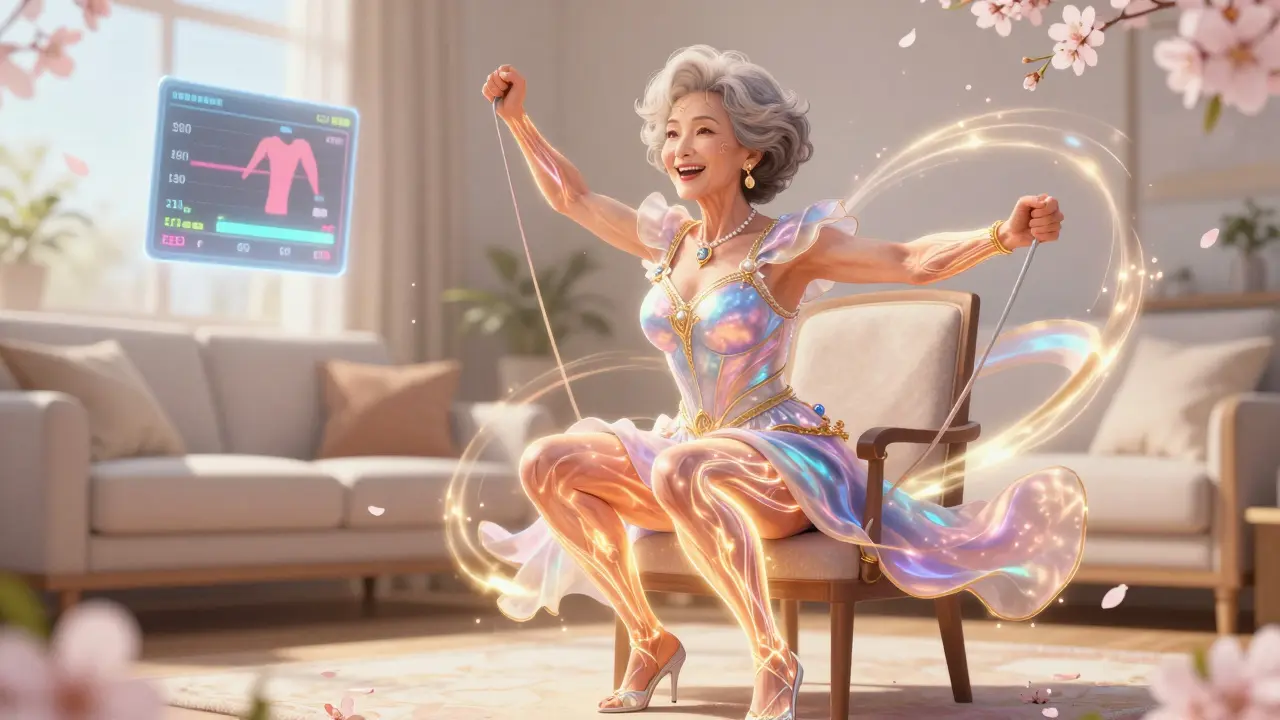
By your 40s, you might start noticing small changes: carrying groceries feels heavier, stairs take more effort, or you’re sitting down to get up from a chair instead of standing. These aren’t just signs of getting older-they could be early signals of sarcopenia, the slow, silent loss of muscle mass and strength that begins in your 30s and accelerates after 65. Unlike a sprained ankle or a cold, sarcopenia doesn’t come with a fever or a cast. It creeps in quietly, eroding your ability to move, balance, and live independently. But here’s the good news: it’s not inevitable. Strength training isn’t just for bodybuilders. For older adults, it’s the most powerful tool we have to fight back.
What Exactly Is Sarcopenia?
Sarcopenia isn’t just feeling weaker. It’s a medical condition defined by a measurable drop in muscle mass, strength, and physical performance. First named in 1989 by Dr. Irwin Rosenberg, it wasn’t officially recognized as a distinct diagnosis until 2010 by the European Working Group on Sarcopenia in Older People (EWGSOP). Their guidelines were updated in 2018 and again in 2023, and now doctors use three clear markers to diagnose it: handgrip strength below 27kg for men or 16kg for women, walking speed slower than 0.8 meters per second, and low lean muscle mass-under 7.0kg/m² for men and 5.5kg/m² for women, measured by a DXA scan.
It’s not the same as general muscle atrophy from being bedridden, or cachexia from cancer or severe illness. Sarcopenia is specifically tied to aging. Even if you’re not sick, your body starts losing muscle at a rate of about 1-2% per year after age 40. By 65, that picks up to 8% per decade. By 80, many people have lost 30-40% of their fast-twitch muscle fibers-the ones that give you power to stand up quickly or catch yourself if you trip.
Behind the scenes, your muscles are fighting a losing battle. Motor neurons that connect your brain to your muscles die off. Satellite cells, which repair and rebuild muscle, become less active. Your body also produces less of the proteins needed for muscle growth, and inflammation levels rise. All of this adds up: by age 70, your ability to regenerate muscle drops by half.
Why It Matters More Than You Think
Sarcopenia doesn’t just make you weaker-it makes you vulnerable. Losing muscle means losing balance. Losing balance means falling. Falls are the leading cause of injury-related hospitalizations in people over 65. One fall can lead to a broken hip, months in rehab, and a permanent loss of independence.
The financial toll is huge. In the U.S. alone, sarcopenia costs $18.5 billion each year in medical care, long-term support, and lost productivity. And it’s getting worse. By 2050, one in six people worldwide will be over 65. That means millions more people at risk.
But here’s the thing: sarcopenia doesn’t have to mean decline. Studies show that older adults who maintain muscle strength are far more likely to keep cooking, cleaning, walking to the store, and living on their own. One 2022 survey of over 3,200 older adults found that 75% of those who did strength training twice a week kept their daily independence. Only 58% of those who didn’t train did.
How Strength Training Reverses Muscle Loss
There’s no magic pill for sarcopenia. No supplement, no injection, no trendy diet. The single most proven, effective, and accessible intervention is strength training. Multiple studies confirm it: lifting weights-even light ones-can add 1-2kg of muscle and boost strength by 25-30% in just 12 to 16 weeks.
How does it work? When you lift, your muscles send signals to your body to build more protein, repair damaged fibers, and activate dormant satellite cells. Even in your 70s or 80s, your muscles still respond. They just need the right stimulus.
Research from the University of Pittsburgh shows that twice-weekly resistance training improves walking speed by 0.1 to 0.2 meters per second-enough to cross a street safely before the light changes. It also cuts fall risk by 30-40%. That’s not a small benefit. That’s life-changing.
And it’s not about going to the gym and lifting heavy. You don’t need a barbell. You don’t need fancy equipment. You just need to challenge your muscles.
Getting Started: Simple, Safe, and Effective
If you’ve never lifted weights before, start slow. The CDC recommends beginning with bodyweight exercises:
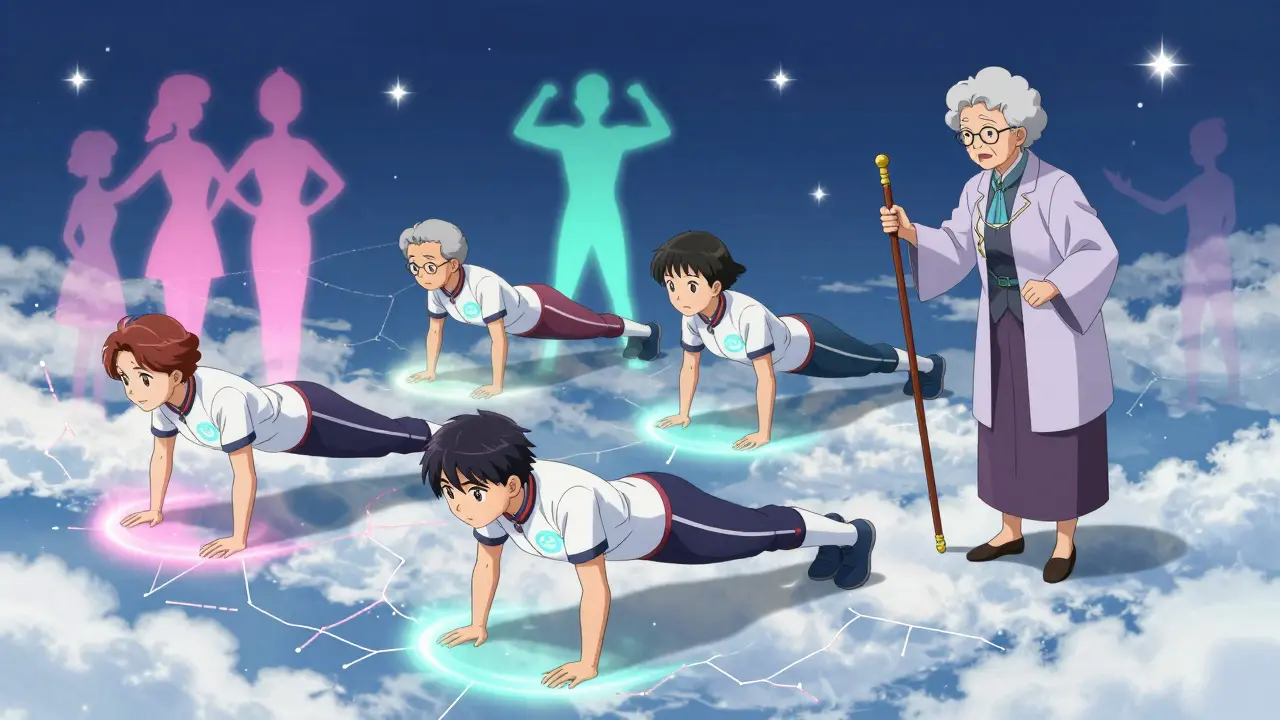
- Chair squats: Stand in front of a sturdy chair, lower yourself slowly until you almost sit, then stand back up.
- Wall push-ups: Stand arm’s length from a wall, place your hands on it, and push your body away.
- Seated leg extensions: Sit in a chair, straighten one leg, hold for a second, then lower slowly.
Do these 2-3 times a week. Two sets of 10-15 reps each. Focus on control, not speed. Breathe out as you push or lift, breathe in as you lower.
After a few weeks, add resistance bands (TheraBand is a common brand). Start with the lightest resistance (yellow or red). Loop it around your legs or hold it in your hands for bicep curls, rows, or shoulder presses. Aim for 10-15 reps per set.
Once you’re comfortable, move to weight machines at the gym. Machines are safer than free weights for beginners because they guide your movement. Use 60-70% of your maximum weight-meaning the last 2 reps should feel hard, but you can still do them with good form. Increase the weight by 2.5-5% every week or two. That’s called progressive overload. It’s how muscles grow.
Always rest at least 48 hours between strength sessions. Muscles grow when you rest, not when you lift.
What About Pain, Balance, and Motivation?
Many older adults quit because of pain, fear, or frustration. Joint pain? Try seated exercises or machines that limit range of motion. Balance issues? Start seated. Hold onto a table or chair for support. Feeling too tired? Start with just 10 minutes. Consistency beats intensity.
Motivation is the biggest hurdle. That’s why group programs work so well. A 2022 study from the National Institute on Aging found that people who trained in groups were 35-40% more likely to stick with it. Programs like SilverSneakers-covered by many Medicare Advantage plans-are designed for older adults. They’re low-pressure, social, and led by trainers who know how to adapt exercises for arthritis, osteoporosis, or mobility limits.
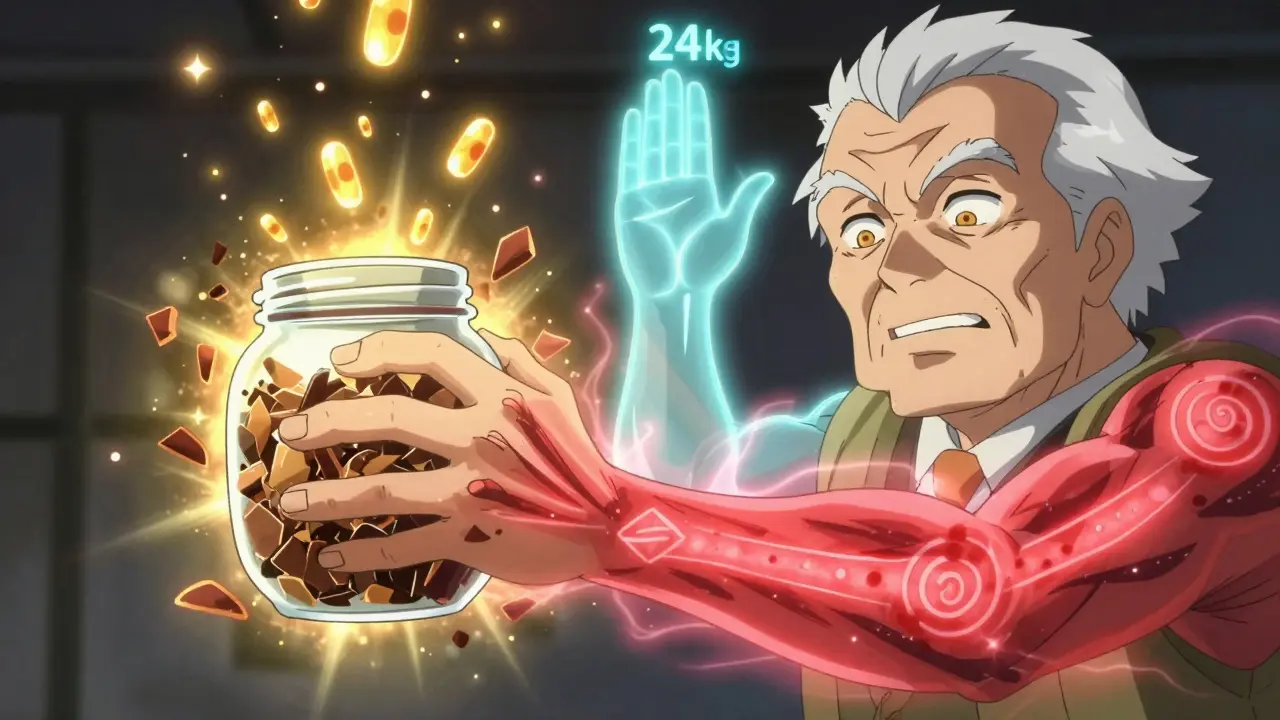
One 68-year-old man on a fitness forum said his handgrip strength jumped from 18kg to 24kg after six months. He could finally open stubborn jars. A 72-year-old woman in a Healthgrades review said her fall risk score dropped from 42 to 28 after a 10-week SilverSneakers program. These aren’t outliers. They’re proof that change is possible.
Protein: The Missing Piece
Strength training alone isn’t enough. Your muscles need fuel. After age 65, your body becomes less efficient at using protein to rebuild muscle. That’s why timing matters.
International guidelines recommend getting 20-30 grams of high-quality protein within 45 minutes after your workout. That’s about:
- One cup of Greek yogurt
- Three eggs
- A chicken breast
- A protein shake with whey or casein
Spread your protein intake across meals too. Aim for 25-30g per meal, not just one big serving at dinner. Your body can only use so much at once.
What Doesn’t Work
Cardio alone won’t stop sarcopenia. Walking, swimming, and cycling are great for your heart-but they don’t build muscle. Stretching improves flexibility, but not strength. Supplements like creatine or vitamin D may help a little, but they’re no substitute for lifting.
And while some companies are developing drugs to treat sarcopenia-like RT001, a mitochondrial therapy now in clinical trials-none are approved yet. And even if they were, they wouldn’t replace the benefits of movement. Exercise doesn’t just build muscle. It improves nerve signaling, reduces inflammation, and boosts mood. No pill can do all that.
What’s Next?
The future of sarcopenia care is getting smarter. Researchers are testing blood tests that detect early signs of muscle loss by measuring proteins like myostatin and GDF-15. AI-powered apps like Exer AI give real-time feedback on form and adjust workouts based on your progress-boosting adherence by 25% in early trials.
But right now, the most powerful tool is already in your hands. You don’t need a prescription. You don’t need to wait for a breakthrough. You just need to start moving-safely, consistently, and with purpose.
It’s never too late. Even if you’re 75, 80, or 85, your muscles still remember how to grow. All they need is a reason-and a little effort.
Is sarcopenia the same as muscle atrophy?
No. Muscle atrophy can happen at any age due to injury, illness, or inactivity-like losing muscle after being bedridden. Sarcopenia is specifically age-related muscle loss that begins in your 30s or 40s and progresses naturally over time, even if you’re active. It’s defined by both loss of muscle mass and decline in strength and function.
Can I build muscle after 70?
Absolutely. Studies show older adults can gain 1-2kg of muscle and increase strength by 25-30% in just 12-16 weeks with consistent strength training. Your muscles respond to resistance at any age-you just need to start slowly and progress safely.
How often should I strength train if I’m over 65?
The American College of Sports Medicine recommends 2-3 sessions per week, targeting all major muscle groups. Rest at least 48 hours between sessions to allow muscles to recover. Even two 20-minute sessions can make a difference.
Do I need to go to a gym to fight sarcopenia?
No. You can start with bodyweight exercises at home-chair squats, wall push-ups, seated leg lifts. Resistance bands are inexpensive and effective. Many community centers and Medicare Advantage plans offer free or low-cost senior fitness programs like SilverSneakers that require no gym membership.
What if I have arthritis or joint pain?
Strength training can actually help joint pain by strengthening the muscles around them. Use machines instead of free weights, avoid deep ranges of motion, and focus on controlled movements. Water-based exercises and seated resistance training are also excellent options. Always talk to your doctor or a physical therapist before starting if you have chronic pain.
Is walking enough to prevent sarcopenia?
Walking is great for heart health and endurance, but it doesn’t build muscle. To fight sarcopenia, you need resistance-something that makes your muscles work harder than normal. That means lifting, pushing, or pulling against resistance. Combine walking with strength training for the best results.
How long until I see results from strength training?
Most people notice improved strength and easier movement within 4-8 weeks. Gains in muscle mass typically show up after 12-16 weeks. But even small improvements-like standing up from a chair without using your hands or carrying a bag of groceries without pain-are meaningful wins.
Start today. Not tomorrow. Not next week. Today. One set of chair squats. One band curl. One step toward staying strong, independent, and in control of your body-for as long as possible.


Randolph Rickman
Just started doing chair squats and wall push-ups last week-was skeptical, but my knees don’t creak as much getting out of the car now. No magic, just consistency. My 71-year-old neighbor did the same and finally stopped using his cane indoors. You don’t need to be a gym rat. You just need to show up.
It’s not about lifting heavy. It’s about lifting often. And yeah, protein matters too. Had a Greek yogurt after my first session. Felt like I’d done something real for the first time in years.
Billy Poling
While I appreciate the optimism presented here, one must consider the broader systemic neglect of geriatric musculoskeletal health in the American medical paradigm. The fact that sarcopenia was only formally recognized as a diagnosis in 2010 speaks volumes about the prioritization of acute interventions over preventive gerontology. Insurance companies do not reimburse for resistance training programs, and primary care physicians receive no incentive to screen for grip strength or gait velocity. This is not a personal failure-it is a structural failure of healthcare policy. Until we integrate functional capacity assessments into annual physicals, we are merely bandaging a hemorrhage with tissue paper.
Furthermore, the emphasis on individual responsibility ignores the social determinants of health: food insecurity, lack of safe walking spaces, and isolation all contribute to physical decline. To suggest that simply doing chair squats will reverse decades of systemic neglect is not only reductive, it is morally irresponsible.
sue spark
I’ve been doing bands at home since my hip replacement and I swear I can reach the top shelf again. No fancy gear just a red band and a chair. It’s quiet but it works
James Rayner
There’s something deeply poetic about the body remembering how to grow, even when the mind has long accepted decline as inevitable. We think of aging as erosion-but what if it’s just silence? The muscles aren’t gone. They’re waiting. For the signal. For the push. For the breath held too long, then released with purpose.
I lost my father to a fall at 82. He never lifted a weight in his life. But he used to fix clocks. He had hands that could thread a needle blindfolded. I wonder if he knew, somewhere beneath the ache, that his body still wanted to be strong. Maybe we don’t need more science. Maybe we just need to listen harder.
And yes. Protein matters. But so does the quiet dignity of standing up without help. That’s the real victory. Not the numbers on the scale. Not the grip strength chart. Just… being able to rise.
❤️
Josias Ariel Mahlangu
Let me be clear: this is the result of decades of moral decay. People used to work for a living. They carried wood, dug ditches, raised livestock. Now we sit on couches and call it 'lifestyle.' We eat processed garbage and wonder why our bodies betray us. No pill, no band, no 'SilverSneakers' program can fix what a generation of laziness has broken.
My grandfather worked on a farm until he was 84. He didn't need a trainer. He didn't need a study. He just didn't quit. That's the real lesson here-not exercise, but discipline. And discipline is a virtue most have forgotten.
Andrew Sychev
THIS IS ALL A LIE. SARCOPENIA IS A PHARMA SCAM TO SELL PROTEIN SHAKES AND FITNESS SUBSCRIPTIONS. YOU KNOW WHY THEY PUSHED 'STRENGTH TRAINING' AS THE SOLUTION? BECAUSE GYMS MAKE BILLIONS OFF OLD PEOPLE WHO THINK THEY CAN 'OUTLIFT TIME.'
REAL SCIENCE? THE BODY JUST SHUTS DOWN MUSCLE PRODUCTION BECAUSE IT’S TELLING YOU TO REST. YOU’RE NOT WEAK. YOU’RE WISE. BUT THEY’RE SCARING YOU INTO BUYING THERABANDS AND WHEY PROTEIN.
MY 80-YEAR-OLD AUNT NEVER LIFTED A WEIGHT. SHE SAT IN HER ROCKER. LIVED TO 98. NO FALLS. NO HOSPITALS. JUST PEACE. WHAT DID YOU GAIN? A TIGHTER BUTT? A BETTER GRIPTH? WHO CARES.
THEY WANT YOU AFRAID. DON’T FALL FOR IT.
Kim Hines
I tried the seated leg extensions last night. Took me three tries to get the form right. Felt weird. But tomorrow I’ll do it again. Just one set. That’s enough for now.
Cassandra Collins
okay but what if the government is using sarcopenia to justify forcing old people into gyms so they can track their biometrics through the new Medicare app??
they already have your blood sugar and your heart rate now they want your grip strength??
and why is everyone talking about silver sneakers like its a miracle when its run by some company that got a contract from unitedhealth??
i dont trust this. i think its all part of the big fitness surveillance network. i saw a lady on tiktok say her tracker beeped when she skipped leg day and she cried.
im not doing it. im staying in my chair. and i dont care what the studies say.
Dylan Smith
James Rayner’s comment hit me right in the chest. My mom’s 79 and she just started with resistance bands after her knee surgery. She didn’t tell anyone. Just did it in the living room while watching Judge Judy. Last week she carried her own laundry basket up the stairs. Didn’t say a word about it. I asked her how she did it. She said, 'I just wanted to be able to hug my grandkids without my arms shaking.'
That’s the real goal. Not the numbers. Not the stats. Just being able to hold them.
And yeah, protein after the workout? I started making her scrambled eggs with a scoop of whey in it. She hates the taste but eats it because she knows I’m not giving up. We’re doing this together. Not because we have to. Because we want to.
One set. One egg. One hug. That’s enough.
Thank you for writing this. It’s not just advice. It’s a lifeline.