When a child needs medicine, parents and doctors often assume that a generic version is just as safe and effective as the brand-name one. But for kids, that assumption can be dangerous. Generic drugs for children aren't always interchangeable with their brand-name counterparts, and the risks aren't always obvious. Many of these drugs were never tested in kids, yet they’re prescribed anyway - and that’s where things go wrong.
Why Kids Aren’t Just Small Adults
Children’s bodies don’t process medicine the same way adults’ do. Their livers, kidneys, and nervous systems are still developing, especially under age two. A dose that’s harmless to an adult might overload a baby’s system. For example, acetaminophen is less likely to cause liver damage in young children because they produce more glutathione - a natural detoxifier. But that doesn’t mean all generic versions of it are safe. Some contain different inactive ingredients, like preservatives or flavorings, that can trigger allergic reactions or upset stomachs in sensitive kids.Aspirin is another clear case: it’s completely banned for kids under 19 because of Reye’s syndrome, a rare but deadly condition that affects the brain and liver. Even if a generic aspirin tablet has the same active ingredient, it’s still unsafe. And then there’s lamotrigine, a seizure medication. Kids are three times more likely than adults to develop Stevens-Johnson syndrome - a life-threatening skin reaction - when taking this drug, regardless of whether it’s brand or generic.
The Hidden Risks in Inactive Ingredients
The FDA requires generic drugs to have the same active ingredient as the brand-name version. But what’s in the rest of the pill or liquid? That’s where the trouble starts. Preservatives, dyes, sweeteners, and fillers can vary wildly between brands. For a child with allergies or sensitivities, even tiny changes can cause problems.Take benzocaine, a common topical numbing agent found in teething gels. The FDA warns against using it in children under two because it can cause methemoglobinemia - a condition where blood can’t carry oxygen properly. A 2023 case in Ohio involved a 14-month-old who stopped breathing after a generic teething gel was applied. The active ingredient was fine. The problem? A different preservative used in the generic version.
Same story with lidocaine viscous. It’s sometimes used for mouth sores, but it’s not meant to be swallowed. In infants, even a small amount can cause seizures or heart rhythm problems. Brand-name versions come with clear warnings. Generic versions? Often they don’t. And many parents don’t realize the difference.
The KIDs List: What Doctors Are Using to Stay Safe
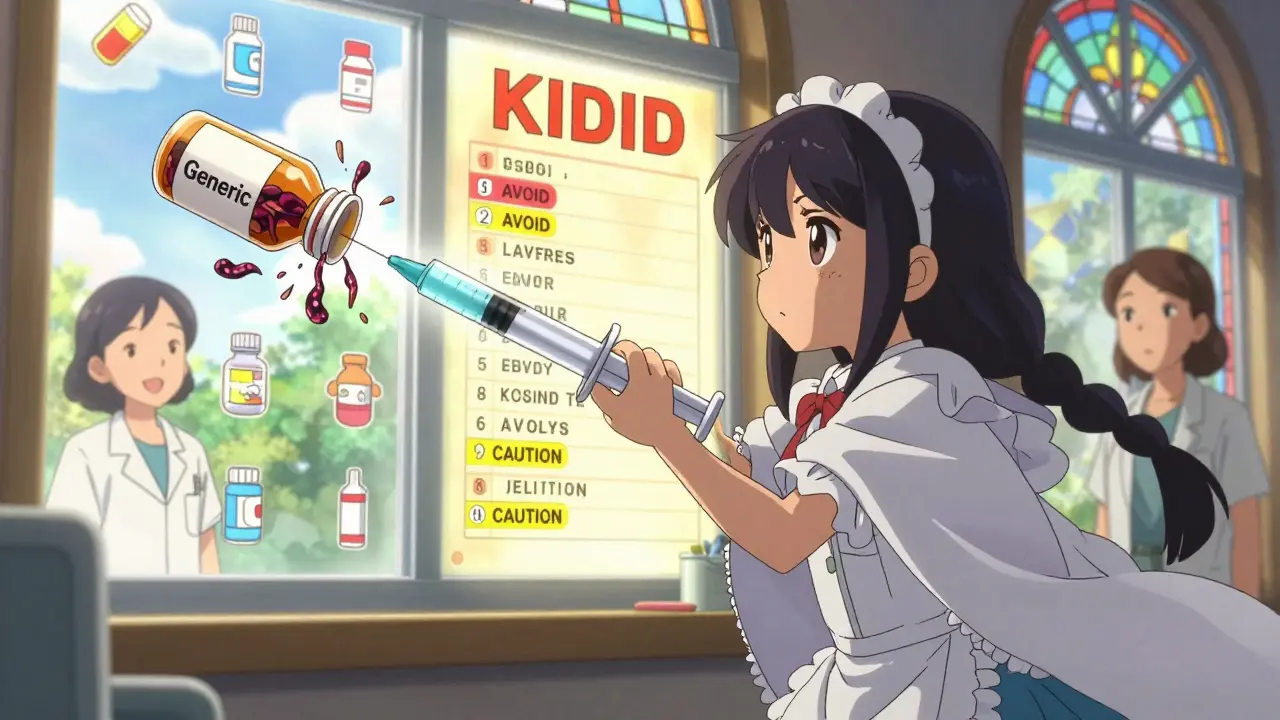
The Pediatric Pharmacy Association created the KIDs List - a practical guide for clinicians. It’s not a list of bad drugs. It’s a list of drugs that are risky for kids, whether they’re brand or generic. The 2025 update includes over 4,100 medications with specific safety notes.For example:
- Promethazine (a generic antihistamine): Avoid in kids under two. Risk of fatal breathing problems. Use with extreme caution in kids up to 18.
- Trimethobenzamide (an anti-nausea drug): Avoid in anyone under 18. Can cause severe muscle spasms, especially in teens.
- Betamethasone (a steroid cream): Avoid on diaper rash in kids under two. Can lead to adrenal suppression or Cushing syndrome.
- Linaclotide (newly added in 2025): Use caution in kids under two. Risk of severe dehydration and death.
- Guaifenesin (cough syrup): Avoid in kids under four. No proven benefit. High risk of vomiting and choking.
These aren’t theoretical risks. These are real cases - some fatal - that led to these warnings. The KIDs List doesn’t just say “avoid.” It rates the evidence: strong, moderate, or low. And it tells you why.
Off-Label Prescribing: The Norm, Not the Exception
Here’s the uncomfortable truth: about 40% of all pediatric prescriptions are off-label. That means the drug wasn’t approved by the FDA for that age group, dosage, or condition. And 90% of those prescriptions are filled with generics.Why? Because there’s often no pediatric-specific version available. A child might need a 5 mg dose of a drug, but the only generic available comes in 10 mg tablets. Parents or doctors end up cutting pills, crushing them, or mixing them with food - all of which increase dosing errors.
One study found that pediatric dosing errors happen three times more often than in adults. Why? Because most generic labels don’t include pediatric dosing. A doctor might guess the dose based on weight - but if the label doesn’t say “for children,” they’re flying blind.
How Medication Errors Happen - And How to Stop Them
The most common mistakes? Weight miscalculations, wrong liquid concentration, and using adult formulations.- Weight errors: 45% of errors happen because a dose was calculated using pounds instead of kilograms, or vice versa.
- Concentration confusion: Liquid medications come in different strengths - 10 mg/mL, 25 mg/mL, 100 mg/mL. Using the wrong one can mean a 10-fold overdose.
- Wrong device: A teaspoon isn’t 5 mL. A kitchen spoon varies by 20-30%. Oral syringes are the only safe way to measure.
- Adult drugs for kids: A parent might use adult ibuprofen because it’s cheaper. But adult tablets contain fillers that can irritate a child’s stomach or trigger allergies.
Dr. John van den Anker calls it the “zero rule”: never write a dose as 1.0 mg. Write it as 1 mg. A decimal point can be missed. That 1.0 mg becomes 10 mg. And for a baby, that’s a fatal mistake.
What Parents Should Do - Right Now
You don’t need to be a pharmacist to keep your child safe. Here’s what works:- Ask if the generic is approved for kids. If the label doesn’t say “for children” or “pediatric use,” ask for the brand or a pediatric-specific version.
- Use oral syringes - never spoons. Buy them at any pharmacy. They cost less than $2.
- Check the concentration. If the bottle says “100 mg/5 mL,” don’t assume it’s the same as another bottle. Write it down.
- Don’t mix medicines. Cold syrups often contain the same active ingredients as fever reducers. Double-dosing acetaminophen is the leading cause of liver failure in kids.
- Keep a medication list. Include everything: vitamins, herbal drops, cough syrups. Update it every time something changes.
- Call the pharmacy if the pill looks different. Color, shape, or taste changes? That’s not a coincidence. It’s a different formulation. Ask if it’s safe.
One mom in Texas told her story on Reddit: her 3-year-old developed severe diarrhea after switching from brand-name loperamide to a generic. The pharmacy didn’t warn her. The doctor didn’t know. The label didn’t say anything. It took three emergency visits before they figured out the preservative in the generic was the culprit.
The Future: Better Labels, Better Drugs
The FDA’s 2024 guidance requires generic manufacturers to include pediatric dosing information when it exists - and to start testing for pediatric safety when requested. Full compliance is due by December 2025. That’s a step forward.Some companies are already responding. Pediatric-specific formulations - like chewable tablets, sugar-free suspensions, and taste-masked liquids - are growing at 6.2% a year. AI tools are being tested to predict safe dosing for generics, with early accuracy rates hitting 89%.
But until every generic drug is tested in children, the burden falls on parents and providers. The safest choice isn’t always the cheapest. Sometimes, it’s the one with the clearest label - and the one your doctor specifically chose.
Are generic drugs always safe for children?
No. While generic drugs have the same active ingredient as brand-name versions, they can differ in inactive ingredients like preservatives, dyes, and flavorings. These can cause allergic reactions, digestive issues, or even serious side effects in children, especially under age two. Many generics lack pediatric-specific dosing information, increasing the risk of dosing errors.
What is the KIDs List and why does it matter?
The KIDs List (Key Potentially Inappropriate Drugs List) is a safety guide developed by the Pediatric Pharmacy Association. It identifies over 4,100 drugs with known or potential risks for children, including both brand-name and generic versions. It categorizes drugs as "avoid" or "caution" based on evidence strength and severity of risk. For example, promethazine and trimethobenzamide are flagged for serious respiratory and neurological risks in kids. It’s used by pediatricians to avoid dangerous prescriptions.
Can I switch my child’s generic medication without asking the doctor?
No. Even if two generics have the same active ingredient, differences in fillers, flavorings, or concentration can affect safety and effectiveness in children. Always consult your child’s doctor or pharmacist before switching. You can also ask your doctor to write "Dispense as written" on the prescription to prevent automatic substitution.
Why are liquid medications riskier for kids?
Liquid medications are the leading cause of pediatric dosing errors - accounting for 37% of all mistakes. Different concentrations (like 10 mg/mL vs. 25 mg/mL) are easily confused. Parents often use kitchen spoons instead of oral syringes, which can lead to 20-30% dosing errors. Always use a calibrated oral syringe and double-check the concentration on the bottle before giving the dose.
What should I do if my child has a reaction after switching to a generic drug?
Stop the medication immediately and contact your pediatrician. Document the reaction - what symptoms appeared, when, and what the drug looked like (color, shape, label). Report it to the FDA’s MedWatch program. Many reactions are preventable and are linked to changes in inactive ingredients. Your doctor may need to switch back to the brand-name version or find a safer generic alternative.