

When someone suddenly slurs their words, drops a cup, or can’t raise one arm - and then, just as quickly, everything goes back to normal - many people breathe a sigh of relief. TIA - transient ischemic attack - is often dismissed as a "mini-stroke." But that term is dangerously misleading. A TIA isn’t a mild warning. It’s a full-blown neurological emergency that signals your brain is in immediate danger. And if you ignore it, you’re gambling with your life.
Here’s the hard truth: 1 in 5 people who have a TIA will have a full stroke within 90 days. And half of those strokes happen in the first 48 hours. That’s not a remote risk. That’s a ticking clock. The good news? If you act fast, you can stop it before it starts.
What Exactly Is a TIA?
A TIA happens when blood flow to part of your brain is briefly blocked - usually by a clot. The symptoms are identical to a stroke: sudden face drooping, arm weakness, slurred speech, vision loss, dizziness, or a severe headache with no clear cause. But unlike a stroke, the blockage clears on its own, often within minutes. No permanent damage shows up on an MRI. No scar tissue forms. That’s why people think it’s nothing.
But modern medicine has changed the game. In 2023, the American Heart Association officially dropped the old 24-hour rule. A TIA is no longer defined by how long symptoms last. It’s defined by what’s not there: no brain tissue death. If an MRI shows even a tiny area of damage - even if symptoms vanished in 10 minutes - it’s not a TIA. It’s a minor stroke.
That’s why 35% of people who think they had a TIA are later found to have had a stroke. Advanced imaging doesn’t lie. And that’s why calling it a "mini-stroke" is not just inaccurate - it’s deadly. You wouldn’t ignore a smoke alarm because the fire went out. A TIA is your brain’s smoke alarm.
How to Spot the Difference Between TIA and Stroke
The symptoms? Exactly the same. The difference? One leaves permanent damage. The other doesn’t - but it almost always leads to one.
Let’s break it down:
- TIA: Symptoms start suddenly, peak within minutes, and fully disappear - usually within 10 to 60 minutes. No lasting weakness. No memory loss. No scan shows injury. But your risk of stroke in the next few days is sky-high.
- Stroke: Symptoms start suddenly and don’t go away. Even if they seem mild, brain tissue is dying. Every minute counts. Treatment like clot-busting drugs (alteplase) only works if given within 4.5 hours.
Here’s the catch: You can’t tell the difference on your own. Not even doctors can, just by looking. That’s why any sudden neurological symptom - even if it’s gone - means call 911. Don’t wait. Don’t drive yourself. Don’t hope it won’t happen again.
And here’s another surprise: 48% of people who had what doctors called a TIA actually had subtle brain damage detectable only by advanced MRI scans. That means many "TIA" patients already have permanent injury - they just didn’t feel it. The brain doesn’t always scream when it’s hurt.
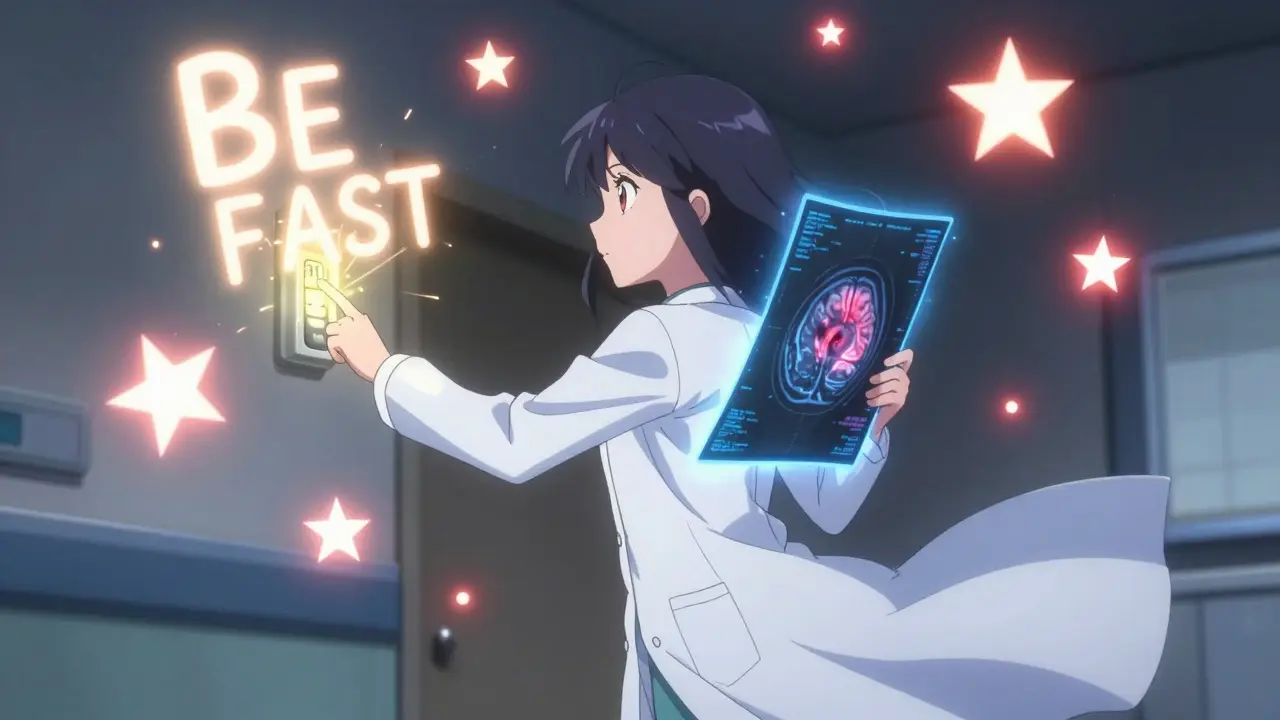
The BE FAST Mnemonic: Your Lifesaver
Forget complicated medical jargon. Use BE FAST - and use it the moment you see any sign:
- Balance: Sudden dizziness, loss of coordination, or trouble walking - no vertigo, no cause.
- Eyes: Blurry, double, or total vision loss in one or both eyes.
- Face: One side droops. Ask them to smile. Is it uneven?
- Arm: One arm drifts down when raised. Can they hold both up evenly?
- Speech: Slurred, strange, or impossible to repeat. "How are you today?" - if they can’t say it right, it’s a red flag.
- Time: Call 911 now. Don’t wait. Don’t text. Don’t call your doctor tomorrow. Every minute matters.
This works for both TIA and stroke. And if symptoms disappear while you’re on the phone? Still call 911. Still go to the ER. Still get scanned. That’s not overreacting - that’s saving your life.
Why Timing Is Everything
The clock starts the moment symptoms begin - not when you decide to act.
Studies show that if you get evaluated within 60 minutes of symptom resolution, your stroke risk drops by 80%. That’s not a guess. That’s data from the SOS-TIA program at Massachusetts General Hospital. Patients seen the same day had a 1.2% chance of stroke in 90 days. Those who waited more than 24 hours? 10.3%.
That’s nearly a 9-fold difference.
Emergency rooms now use a tool called the ABCD2 score to predict risk:
- Age: 60 or older? 1 point.
- Blood pressure: Over 140/90? 1 point.
- Clinical features: Weakness on one side? 2 points. Just speech trouble? 1 point.
- Duration: Symptoms lasted 60+ minutes? 2 points. 10-59 minutes? 1 point.
- Diabetes? 1 point.
Score of 4 or higher? You’re in the high-risk zone. That means hospital admission. That means MRI within 24 hours. That means starting aspirin and clopidogrel within hours.
And yes - aspirin 325 mg taken within 24 hours cuts your stroke risk by 60%. But only if you take it. And only if you get it in time.
What Happens After the ER?
Getting to the ER is step one. The real work starts after.
Once you’re cleared - whether you had a true TIA or a minor stroke - you need a full prevention plan:
- Antiplatelet therapy: Aspirin plus clopidogrel for 21-30 days. This combo reduces early stroke risk more than aspirin alone.
- High-intensity statin: Atorvastatin 80 mg daily. Lowers cholesterol aggressively to stabilize artery plaques.
- Blood pressure control: Keep it under 140/90. Even if you’re young, even if you feel fine.
- Heart monitoring: 24-48 hour Holter monitor to catch atrial fibrillation - a hidden cause of clots.
- Carotid ultrasound: If you had weakness or speech issues, they’ll check for artery blockage in your neck.
And if you’re still smoking? Quit today. Still drinking heavily? Cut it back. Still sedentary? Start walking. These aren’t "nice to haves." They’re your next line of defense.
The Myth That Kills
The biggest danger isn’t the TIA itself. It’s the belief that "if it’s gone, it’s nothing."
One in three people who have a TIA wait more than 24 hours to get help. Why? Because they think it’s over. Because they think they’re fine. Because they were told it was "just a mini-stroke."
That’s why public education is as urgent as medical treatment. A TIA is not a warning sign. It’s the first stroke - one that didn’t stick. But the next one might.
Dr. Steven Levine, chief of cerebrovascular neurology at Northwell Health, says it best: "TIA is not a warning. It’s an actual stroke that resolved on its own." That’s not a metaphor. That’s science.
What You Can Do Right Now
You don’t need to wait for symptoms to act. If you’re over 50, have high blood pressure, diabetes, or a history of smoking - get checked. Ask your doctor about your stroke risk. Get a carotid ultrasound if recommended. Know your numbers.
If you’ve had a TIA - even years ago - you’re still at higher risk. Keep taking your meds. Don’t skip follow-ups. Don’t assume you’re "cured."
And if you ever see someone with sudden neurological symptoms - even if they seem to recover - say this: "Call 911. Now."
Because in this case, speed doesn’t just help. It saves lives.
Is a TIA the same as a stroke?
No. A TIA causes temporary symptoms without brain damage, while a stroke causes permanent tissue injury. But modern imaging shows many "TIAs" actually involve small strokes. The key difference is whether MRI shows infarction - not how long symptoms lasted. Both require emergency care.
Can you have a TIA and not know it?
Yes. Some TIAs cause very mild symptoms - like brief confusion, a single numb finger, or a momentary vision glitch. People often dismiss them as fatigue or stress. But even subtle symptoms can signal major risk. Advanced MRI can detect tiny brain injuries that didn’t cause noticeable symptoms.
Do I need an MRI if my symptoms are gone?
Yes. A CT scan rules out bleeding, but it misses small clots. MRI with diffusion-weighted imaging detects brain damage in 99% of cases - even if symptoms vanished 10 minutes ago. If you had TIA-like symptoms, an MRI within 24 hours is standard care.
Why is aspirin given after a TIA?
Aspirin thins the blood and stops clots from forming. Taking 325 mg within 24 hours of a TIA reduces the chance of a stroke in the next few days by 60%. It’s not a cure - but it’s one of the most effective, immediate actions you can take.
Can a TIA happen to someone young?
Yes. While most TIAs occur in people over 60, they’re rising in younger adults due to obesity, diabetes, and high blood pressure. Cases in people under 45 have increased 30% since 2010. No one is immune - especially if they have risk factors like smoking, poor diet, or family history.
Don’t wait for the next episode. Don’t hope it won’t happen again. If you’ve had a TIA - or think you might have - get evaluated. Today. Not tomorrow. Not next week. Today.




Robert Petersen
Man, this is the kind of post that makes you stop scrolling and actually pay attention. I thought I knew everything about strokes until I read this. The part about the brain’s smoke alarm? Perfect analogy. I’m sharing this with my whole family tonight. No more "oh it’s just a mini-stroke" talk around here.
Alyssa Williams
So simple yet so life saving BE FAST is the real MVP here. I used to think if symptoms go away its fine turns out I was almost dead wrong. My uncle ignored his TIA and had a full stroke 3 weeks later. Dont be like him.
Ernie Simsek
Bro this is wild. 1 in 5 people have a stroke after a TIA?? 😱 I just had a weird moment last week where my speech got fuzzy for like 2 mins. Thought I was just tired. Now I’m sweating. Gonna hit up my doc tomorrow. Also 325mg aspirin? I got that in my medicine cabinet right now. Thanks for the scare lol.
Ojus Save
interesting post. i had a numb hand once and thought it was sleeping wrong. now i think maybe it was tia. should i get scan? im 38 and dont have insurance. what to do?
Stacie Willhite
I’ve been a nurse for 18 years and I still get chills reading this. So many patients come in saying "it went away so I didn’t think it was serious." But the brain doesn’t need to scream for you to hear it. That 48-hour window? That’s your window to change everything. Please don’t wait. Ever.
Jason Pascoe
Really appreciate how this breaks down the science without drowning you in jargon. The BE FAST mnemonic is genius. I’m putting it on my fridge. Also, the statin and dual antiplatelet combo info? That’s gold. Most people don’t know about the 21-30 day window. This should be mandatory reading in high school health class.
Luke Trouten
There’s something deeply unsettling about how our culture treats transient symptoms as inconsequential. We’ve normalized ignoring the body’s signals until they become catastrophic. A TIA isn’t a warning-it’s the first domino. And yet we act like it’s a false alarm. We’ve built systems that reward delayed action. This isn’t just medical ignorance. It’s a systemic failure of perception. We need to rewire how we value urgency.
Rachidi Toupé GAGNON
Boom. Just. Boom. 🚨 This is the wake-up call the world needed. I’m printing this out and taping it to my bathroom mirror. If I ever feel even a whisper of weirdness? I’m calling 911. No questions. No hesitation. Life’s too short for "I thought it was nothing."
Pat Mun
I’ve been thinking about this a lot since my dad had what they called a TIA last year. He swore he was fine because his MRI came back "normal." But the doctor pulled me aside and said, "It’s not normal. It’s just invisible." That stuck with me. Now I nag him about his meds, his walking, his blood pressure. He hates it. But I’d rather annoy him than bury him. This post says everything I’ve been trying to explain. Thank you.
Neha Motiwala
They’re hiding something. Why is the FDA still allowing aspirin to be sold over the counter for this? Why aren’t they mandating brain scans after any neurological glitch? This is Big Pharma keeping people sick. And why do all the studies come from "Massachusetts General"? Who funds them? I’ve seen the videos. The brain doesn’t heal like this. There’s a cover-up. And they’re using "TIA" as a distraction. Wake up people.
athmaja biju
In India we have no access to MRI or proper stroke centers. People die because they wait 2 days to reach hospital. This article is for rich countries. We need free ambulances, free scans, free aspirin. Stop preaching to the privileged. Tell the government to act.
Craig Staszak
Good breakdown. One thing I’d add-don’t forget the silent ones. Some TIAs manifest as sudden forgetfulness or confusion that fades fast. People chalk it up to aging. But if your 65-year-old mom starts misplacing keys like it’s a game, get her checked. It might not be dementia. It might be a warning.
alex clo
As a medical professional, I appreciate the clarity and evidence-based approach. The shift from symptom duration to imaging-based diagnosis is one of the most significant advances in neurology this decade. This is precisely the kind of public education that saves lives. Thank you for articulating it so well.