

Have you ever picked up your prescription and noticed your pills look different? Maybe the color changed, or the markings on the tablet don’t match last month’s bottle. If you’re taking a generic drug, this isn’t a mistake-it’s generic switching. And while it might seem harmless, for some people, it can have real consequences.
Why Do Generic Medications Keep Changing?
When a brand-name drug loses its patent, other companies can make the same medicine. These are called generics. They have the same active ingredient, same dose, and same intended effect. But they’re made by different companies, with different fillers, coatings, and manufacturing processes. In the U.S., over 90% of prescriptions are filled with generics. That’s a lot of options. Pharmacies switch between generic manufacturers for one main reason: cost. Insurance companies and pharmacy benefit managers push for the cheapest version available. If Teva’s version of your blood pressure pill is $5 this month and Mylan’s is $3 next month, your pharmacy will likely switch you-without telling you. This isn’t rare. A 2023 study found that patients on certain medications get switched between generic brands every few months. For some drugs, there are four or more manufacturers competing. And because pharmacies don’t always notify prescribers, you might be the first to know something changed.Are All Generics Really the Same?
The FDA says yes. To get approved, a generic must deliver between 80% and 125% of the active ingredient compared to the brand-name drug. That sounds strict. But here’s the catch: two different generics could both be within that range, but still differ from each other by up to 45% in how much medicine actually gets into your bloodstream. Think of it like two different thermometers. One says 98.6°F. Another says 99.5°F. Both are technically “normal,” but if you’re tracking a fever, that half-degree matters. For most drugs, this variation doesn’t cause problems. But for others, it can.When Switching Gets Risky: Narrow Therapeutic Index Drugs
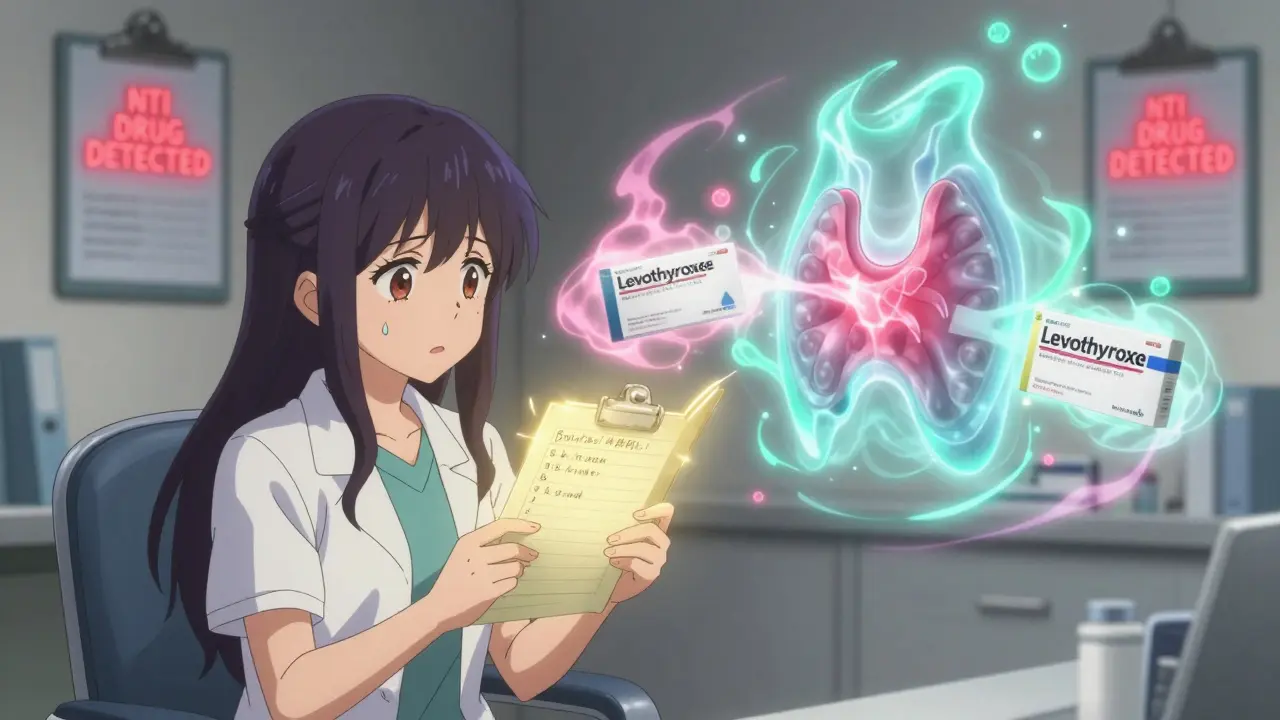
Some medications need to stay within a very tight range in your body. Too little, and they don’t work. Too much, and they become toxic. These are called narrow therapeutic index (NTI) drugs. Switching between generics for these can be dangerous. Examples include:- Levothyroxine (for hypothyroidism): Even small changes in blood levels can make you feel tired, gain weight, or have heart palpitations. Patients report their TSH levels going out of range every time the manufacturer changes.
- Warfarin (a blood thinner): A slight increase in concentration raises bleeding risk. A slight drop raises clot risk. The FDA recommends staying on the same generic version if possible.
- Tacrolimus (for transplant patients): Used to prevent organ rejection. A switch can trigger rejection episodes.
- Phenytoin and other antiepileptics: Seizure control can be lost after a switch. One patient on Reddit reported two breakthrough seizures after switching from Mylan to Teva.
What Patients Are Saying
Real people are feeling the impact. On Drugs.com, a woman wrote: “Every time my levothyroxine manufacturer changes, I feel awful for weeks. My doctor has to adjust my dose. Why can’t they just keep me on one?” Another patient on PharmacyChecker.com said: “I’ve been on generic lisinopril for five years. I’ve been switched five times. Never had an issue.” The data backs this up. Out of 1,247 patient reviews:- 68% reported no problems
- 22% noticed reduced effectiveness
- 10% developed new side effects
Why Doctors Don’t Always Know
Here’s a shocking stat: 62% of physicians say they don’t know when their patients are switched to a different generic manufacturer. Why? Because pharmacies don’t notify them. Insurance rules force the switch. Pharmacists are told to fill the lowest-cost option. A patient might show up to their doctor with new symptoms, and the doctor has no idea the pill they’ve been taking for months suddenly changed shape, color, and maker. That’s a gap in care. Some health systems now use “lock-in” programs for NTI drugs. This means the pharmacy is required to stick with one manufacturer unless the prescriber approves a change. It’s a small step-but it helps.
What You Can Do
You don’t have to wait for a crisis. Here’s how to protect yourself:- Check your pills every time. If they look different, ask the pharmacist: “Is this the same manufacturer as last time?”
- Ask your doctor if your drug is an NTI drug. If it’s levothyroxine, warfarin, tacrolimus, or an antiepileptic, you should be extra cautious.
- Request a specific generic. You have the right to ask your doctor to write “Do Not Substitute” or “Dispense as Written” on your prescription. It’s legal. It’s your right.
- Monitor symptoms. If you feel off after a switch-fatigue, dizziness, mood changes, new side effects-don’t brush it off. Call your doctor. Ask for a blood test if needed.
- Keep a medication log. Write down the name, manufacturer, color, shape, and imprint of your pills. Use a note app or a small notebook. It helps you spot changes fast.
The Bigger Picture
The push for generics saves billions. In 2023, Americans saved $8-10 billion by using generics instead of brand-name drugs. That’s real money. But cost shouldn’t come at the cost of safety. The FDA is starting to pay attention. In 2023, they launched a pilot program requiring generic manufacturers to report any formulation changes. In 2024, Medsafe updated its guidelines to discourage switching levothyroxine brands. The Generic Pharmaceutical Association is working on standardized pill markings to help patients recognize their meds. Still, the system isn’t perfect. Until all manufacturers follow the same labeling rules and doctors are notified of every switch, patients bear the burden.Bottom Line
For most people, switching generics is fine. No harm, no foul. But if you’re on a drug that needs tight control-thyroid, seizure, transplant, or blood-thinning meds-don’t assume it’s safe. Ask questions. Track changes. Advocate for yourself. Your body notices the difference before the pharmacy does.Generic drugs are a vital part of modern healthcare. But they’re not all the same. And sometimes, the cheapest option isn’t the safest one.




Natanya Green
I swear, every time my levothyroxine switches manufacturers, I feel like I’ve been hit by a bus. One month I’m fine, next I’m napping at 3 p.m., crying over spilled coffee… WHY CAN’T THEY JUST KEEP ME ON ONE?!??! 😭
Steven Pam
Honestly? This is such a critical issue that no one talks about. I’ve been on warfarin for 12 years, and I’ve only had one scary incident after a switch. Now I check the pill every time. It’s a small habit that saves lives. You’re not overreacting-you’re being smart.
Michael FItzpatrick
Let’s get real-this isn’t just about pills. It’s about how our healthcare system treats people like disposable data points. Pharmacies are automated vending machines with profit margins, not caregivers. And doctors? They’re stuck between insurance algorithms and paperwork. We’re the ones holding the bag, literally. But here’s the thing: you’re not powerless. You’ve got a voice. Use it. Write to your rep. Ask for a lock-in. Demand transparency. This isn’t just medical-it’s political.
Brandice Valentino
I mean, like, I’ve been on generic lisinopril for years and never had a prob, but I’m just soooo over this whole ‘generic’ thing. Like, why do they even make us take pills that look like they were designed by a toddler with crayons? And why is the imprint always smudged?? I’m not even mad, just… disappointed. 😒
Larry Zerpa
The FDA’s 80-125% range is a joke. That’s a 45% swing. If you were measuring blood pressure with a thermometer that could be off by ±45%, you’d be fired. But apparently, it’s fine to let people die because ‘cost savings.’ This isn’t healthcare. It’s a casino.
Gwen Vincent
I appreciate how balanced this post is. Not everyone has a bad experience, and that’s important to acknowledge. But for those who do? It’s terrifying. I think the real solution is better communication-pharmacies should print the manufacturer name on the label, in bold. And maybe a QR code that links to the pill’s specs. Simple. Effective.
tia novialiswati
Yesss!! 🙌 I started keeping a little pill log in my phone notes-manufacturer, color, shape, imprint. It’s changed my life. Last month, I caught a switch before I even felt weird. Called my doc, they retested my TSH, and we caught it early. You’re not being paranoid-you’re being proactive. Love you for this! 💖
Christopher Brown
Why are we even letting foreign manufacturers make our meds? This is a national security issue. China and India are flooding our market with cheap pills. We used to make our own. Now we’re trusting strangers with our lives. Wake up, America.
Sanjaykumar Rabari
This is all a lie. The government is controlling the pills. They want us weak. The real medicine is in the sun, in the water, in the air. They make you take pills so they can track you. The color changes because of the chip inside. You are being watched. Do not trust the pharmacist. Do not trust the doctor. Do not trust the FDA.
Kenzie Goode
I cried reading this. My mom had a seizure after switching antiepileptics. She was fine for three years. Then-bam. Two weeks later, she was in the ER. No one told us the pill changed. I’ve been screaming about this ever since. If you’re on these meds, please, please, please check your pills. It’s not paranoia. It’s survival.
Cory L
Look, I get it-generics save money. But here’s the secret: the *same* generic, made by the *same* company, in the *same* factory, with the *same* fillers, is often cheaper than switching. Insurance doesn’t care. They just want the lowest bid. The fix? Reward consistency. Pay more for the same manufacturer. It’s not rocket science.
Bhaskar Anand
India makes the best generics. America is weak. We have no backbone. We let big pharma control everything. Why do you think the pills change? Because they want you confused. They want you dependent. Stop complaining. Start buying from Indian pharmacies. They have better quality. And cheaper. You are being manipulated by the system.
William James
I used to think this was just about chemistry. Then I met a guy on a park bench who said, ‘My body knows what it’s used to.’ And he was right. It’s not just about dosage. It’s about rhythm. Our bodies adapt-not just to medicine, but to the ritual of it. The shape, the size, the way it tastes. When that changes? We feel it in our bones. Maybe the science says it’s the same. But the soul? It remembers.
Haley Gumm
I know I’m the only one who noticed this, but… if you’re on levothyroxine and you switch manufacturers, your TSH doesn’t just go out of range-it *lags*. Like, it can take 6-8 weeks to stabilize. So if your doc adjusts your dose after 2 weeks? You’re in danger. That’s why people feel awful. It’s not the pill-it’s the timing. And no one tells you that.