
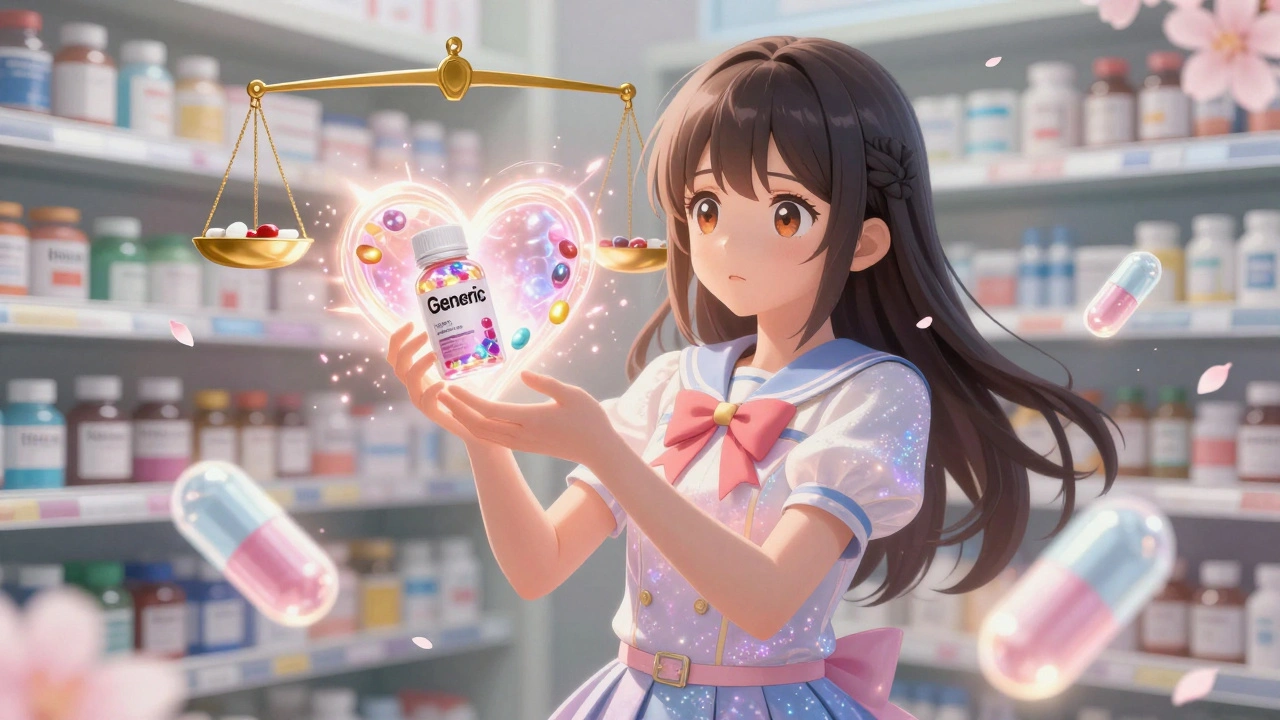
Every year, millions of people in the U.S. and around the world pay hundreds or even thousands of dollars for prescriptions they could get for a fraction of the price. The reason? Many still believe brand-name drugs are better. But here’s the truth: generic medications are just as safe and effective as their brand-name counterparts - and they cost up to 85% less.
What Exactly Are Generic Medications?
Generic medications contain the exact same active ingredients as brand-name drugs. That means if you take a generic version of Lipitor (atorvastatin), you’re getting the same chemical compound that lowers cholesterol as the original. The FDA requires generics to match the brand-name drug in strength, dosage form, route of administration, and how quickly the body absorbs it. This isn’t guesswork - it’s science. To get approved, generics must prove bioequivalence: their blood concentration levels must fall within 80% to 125% of the brand-name version. That’s a tight range, and it’s why doctors and pharmacists trust them.Why Do Generics Cost So Much Less?
Brand-name drug companies spend billions on research, clinical trials, marketing, and patents. That’s why a new pill can cost $300 a month. Generic manufacturers don’t repeat those expensive steps. Once a patent expires, they can use the existing data to prove safety and effectiveness. No need for new animal studies. No need for massive clinical trials. That cuts costs dramatically. And when multiple companies start making the same generic, competition kicks in. One generic? Price drops 30%. Five generics? Price drops nearly 85%. Take warfarin, a common blood thinner. The brand-name version, Coumadin, used to cost over $300 for a 30-day supply. Today, the generic? Around $4. Or fexofenadine, the generic for Allegra. Brand: $30. Generic: $10. These aren’t outliers. They’re the rule.Are Generics Really as Effective?
Yes. And the data proves it. A 2022 study in the Journal of Managed Care & Specialty Pharmacy looked at over 100,000 patients taking generic versus brand-name heart medications. No difference in effectiveness. No increase in hospital visits. No rise in side effects. Another study in the Journal of the American Heart Association tracked 186,000 patients with heart conditions. Again - identical outcomes. Even for complex conditions like epilepsy or high blood pressure, generics perform the same. The FDA has approved over 12,000 generic drugs, and their safety record matches brand-name drugs. In fact, adverse event reports for generics are proportional to how often they’re used - meaning they’re not causing more problems. If anything, patients on generics are less likely to skip doses because they can afford them.What About the Different Colors and Shapes?
It’s normal for generic pills to look different. That’s because inactive ingredients - like dyes, fillers, or coatings - can vary. These don’t affect how the drug works. They just change the color, shape, or size. But that’s where confusion happens. A patient might switch from one generic to another and think, “This isn’t the same.” It is. The active ingredient hasn’t changed. The FDA requires that generics deliver the same amount of medicine into the bloodstream at the same rate. The pill might look different, but it does the same job.
What Do Experts Say?
Dr. Janet Woodcock, former head of the FDA’s drug evaluation division, put it simply: “Generic drugs undergo rigorous review to ensure they are as safe and effective as brand-name drugs.” The American Medical Association recommends prescribing generics whenever possible. Harvard Medical School’s Dr. Aaron Kesselheim, after studying hundreds of thousands of patients, said: “Our research confirms that generic cardiovascular drugs perform as well as their brand-name counterparts.” Even specialists who are cautious - like neurologists dealing with epilepsy drugs - agree: most generics are fine. The FDA’s standards are strict, even for drugs with narrow therapeutic windows. That means even if your body needs a very precise dose, the generic you’re prescribed still meets those exacting standards.How Much Money Can You Save?
The numbers are staggering. From 2012 to 2022, generic drugs saved the U.S. healthcare system $1.67 trillion. That’s not a guess - it’s from the Association for Accessible Medicines. On a weekly basis, generics save $3 billion. Annually? Over $150 billion. For individuals, the difference is life-changing. One Reddit user shared: “Switching my blood pressure meds to generic saved me $280 a month.” Another patient on PatientsLikeMe wrote: “Metformin generics cost me $4 a month versus $300 for Glucophage - this keeps me adherent to my treatment.” Insurance plans know this. Most have tiered copays: $1-$10 for generics, $25-$75 for brand-name drugs. Some plans won’t cover the brand unless you’ve tried the generic first. That’s not a trick - it’s smart policy.What About Biosimilars?
Biosimilars are the next frontier. These are generic versions of complex biologic drugs - things like insulin, rheumatoid arthritis treatments, or cancer therapies. They’re harder to copy than simple pills, but they’re coming. As of December 2023, the FDA had approved 37 biosimilars. They’re not cheap yet, but they’re already saving billions. The Congressional Budget Office estimates biosimilars could save Medicare $50 billion a year by 2030.When Might You Need to Be Careful?
There are rare cases where small differences matter. For drugs with a narrow therapeutic index - meaning the difference between an effective dose and a toxic one is tiny - doctors may monitor levels more closely. Examples include some seizure meds, thyroid drugs, or blood thinners like warfarin. But even here, the FDA requires generics to meet the same strict standards. Most patients switch without issue. If you’ve had a problem before, talk to your doctor. But don’t assume the generic won’t work - ask for data.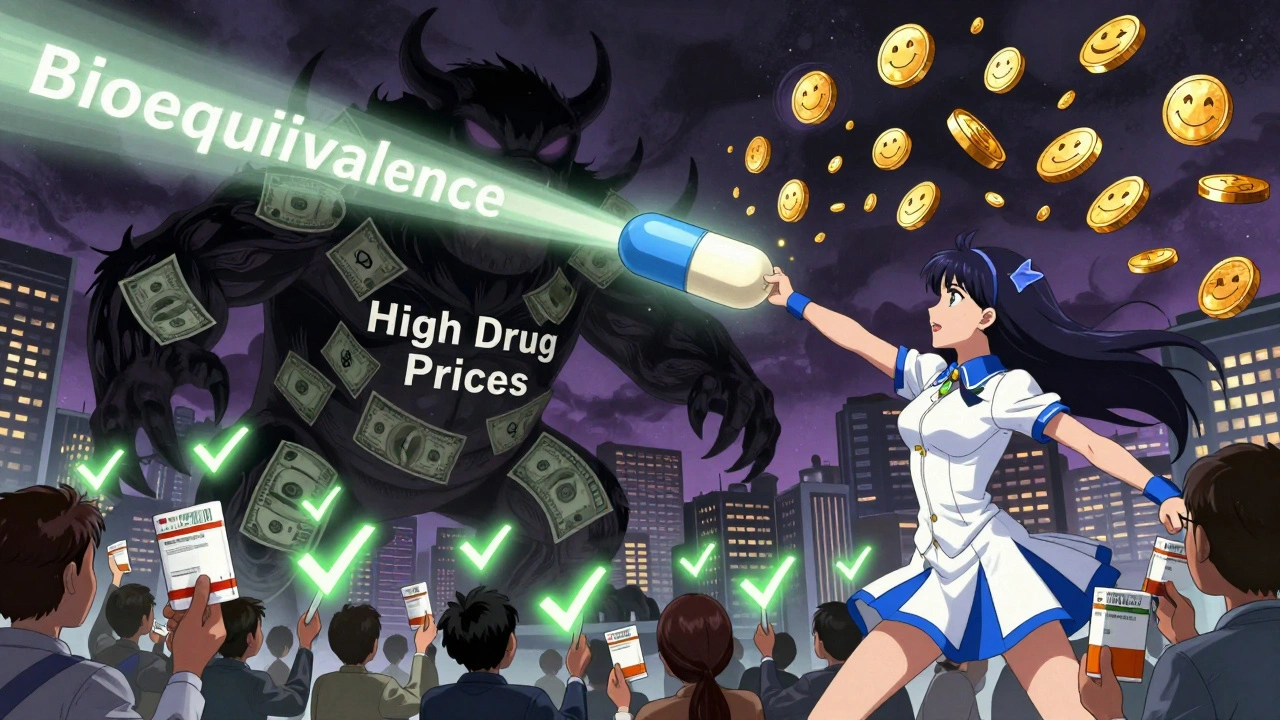
How to Switch Smoothly
Switching is easy. When your prescription renews, ask your pharmacist: “Is there a generic available?” They’ll tell you. Most pharmacies automatically substitute unless the doctor says “dispense as written.” If you’re unsure, ask for the FDA’s Orange Book - it lists all approved generics and their therapeutic equivalence ratings. It’s free online. Your pharmacist can also help you understand why the pill looks different. Many offer free counseling when you switch. Use it. Ask questions. You’re not being difficult - you’re being informed.What’s Holding People Back?
Fear. Misinformation. A belief that “more expensive = better.” But that’s not how medicine works. A $300 pill isn’t stronger than a $4 pill if they contain the same active ingredient. The brand-name drug isn’t better - it’s just older and more expensive. Patients who’ve switched consistently report higher adherence. Why? Because they can afford to take their meds every day. Skipping doses because of cost leads to hospital visits, complications, and higher long-term expenses. Generics fix that.The Bigger Picture
Generic drugs aren’t just a personal savings tool. They’re a public health necessity. As brand-name drug prices keep rising - at over 5% per year - generics are the only thing keeping treatment affordable for millions. Hospitals, pharmacies, insurers, and government programs all rely on them. Without generics, many people would simply stop taking their medicine. The FDA is working to speed up approvals, reduce supply chain risks, and ensure quality worldwide. Their 2023 Drug Competition Action Plan targets barriers that delay generic entry - especially for complex drugs like inhalers and injectables. This isn’t about cutting corners. It’s about making sure safe, affordable medicine reaches everyone.Bottom Line
Switching to generic medications isn’t a compromise. It’s a smart, science-backed choice. You get the same effectiveness, the same safety, and the same results - for a fraction of the cost. If your doctor prescribes a brand-name drug, ask: “Is there a generic?” If your pharmacist switches you without asking, don’t panic. Check the label. Confirm the active ingredient. And keep taking it. You’re not saving money by accident. You’re making a better choice - one that’s backed by decades of research, millions of patients, and the world’s most trusted drug regulator.Are generic medications as safe as brand-name drugs?
Yes. The FDA requires generic drugs to meet the same strict standards for safety, strength, quality, and performance as brand-name drugs. They must prove bioequivalence - meaning they deliver the same amount of active ingredient into your bloodstream at the same rate. Adverse event reports for generics are proportional to how often they’re used, showing no higher risk than brand-name versions.
Why do generic pills look different?
Generics can differ in color, shape, size, or coating because they use different inactive ingredients like dyes or fillers. These don’t affect how the drug works. Only the active ingredient matters for effectiveness. The FDA allows these differences as long as the medicine performs the same way in your body.
Can I trust generics for chronic conditions like high blood pressure or diabetes?
Absolutely. Large studies involving hundreds of thousands of patients with hypertension, heart disease, and diabetes show no difference in outcomes between generic and brand-name versions. In fact, patients on generics are more likely to take their medication consistently because they can afford it - leading to better long-term health.
Do insurance plans encourage using generics?
Yes. Most insurance plans have lower copays for generics - often $1-$10 compared to $25-$75 for brand-name drugs. Some plans require you to try the generic first before covering the brand. This isn’t a loophole - it’s a way to lower costs without sacrificing care.
What if I’ve had side effects with a brand-name drug - will the generic cause the same issue?
If your side effect was caused by the active ingredient, then yes - the generic will likely cause the same reaction because it contains the same active ingredient. But if your reaction was due to an inactive ingredient (like a dye), switching to a different generic might help. Talk to your pharmacist about trying another version. The active ingredient is what matters most.
Are there any drugs where generics aren’t recommended?
For most drugs, generics are recommended. But for a small group called narrow therapeutic index (NTI) drugs - like warfarin, levothyroxine, or some seizure medications - doctors may monitor levels more closely. Even then, the FDA requires generics to meet the same strict standards. Most patients switch without problems. Always consult your doctor before making changes.
How do I know if a generic is approved and safe?
Check the FDA’s Orange Book, which lists all approved generic drugs and their therapeutic equivalence ratings. Your pharmacist can also confirm this. All generics sold in the U.S. must be FDA-approved. If it’s sold legally in a pharmacy, it meets federal safety and quality standards.
Will switching to a generic affect how fast the medicine works?
No. The FDA requires generics to match the brand-name drug’s absorption rate. This is measured through bioequivalence studies that compare how quickly the drug enters your bloodstream (Cmax) and how much is absorbed over time (AUC). If the generic passes, it works the same way, at the same speed.

Scott Butler
Generic drugs? Yeah right. My cousin took some cheap knockoff and ended up in the ER. These companies cut corners to make a buck. We don’t need foreign-made crap in our medicine cabinet.
Emma Sbarge
My pharmacist switched me to generic metformin last year. No side effects. No drop in effectiveness. I’ve saved over $300 a month. If you’re still paying brand prices out of pocket, you’re literally throwing money away.
nina nakamura
Studies show generics are equivalent but people still panic over pill color. The FDA’s 80-125% bioequivalence range is a joke. That’s a 45% variance. You’re not getting the same drug you’re getting statistically acceptable noise. And don’t get me started on manufacturing standards in India and China.
Rawlson King
I used to think generics were fine until my dad’s blood thinner got switched. He started having episodes. Turned out the generic had a different filler that affected absorption. Now I only take brand name. Your life isn’t worth saving $10.
Constantine Vigderman
OMG YES!! I switched to generic Lipitor and my cholesterol dropped even better!! I was scared at first but my pharmacist said it’s literally the same molecule!! I’m so happy I didn’t waste $250/month!! 🙌 Also my dog got a generic flea med and he’s still alive sooo… trust the science!!
Cole Newman
Bro you’re telling people to switch to generics like it’s a no-brainer. What if you’re on a drug with a narrow window like warfarin? You think your PT/INR is gonna stay perfect with some random generic from a factory in Mumbai? Nah. You’re playing roulette with your life.
Casey Mellish
As an Aussie who’s seen our PBS system work for decades, generics are the backbone of affordable healthcare. We’ve had them since the 80s. No spike in hospitalizations. No drop in outcomes. Just lower costs and happier patients. The fear is manufactured by pharma marketing, not science.
Tom Zerkoff
It is important to recognize that the adoption of generic medications represents a significant advancement in public health equity. The empirical data from peer-reviewed journals consistently demonstrates non-inferiority in clinical outcomes. Furthermore, the economic impact on individual patients and the broader healthcare system cannot be overstated. I encourage all patients to engage in informed dialogue with their providers before making therapeutic decisions.
Yatendra S
life is just a pill... and we are all just waiting for the right one to make us whole 💭✨ generics? maybe they're just the universe's way of saying 'you don't need the fancy box to feel the medicine inside'
kevin moranga
Let me tell you something - I was on brand-name insulin for years. $600 a month. I skipped doses. I got sick. Then I switched to generic. $12 a month. I started taking it every day. My A1C dropped from 9.8 to 6.1. I went from being afraid to leave the house to hiking with my kids. This isn’t about saving money. This is about saving your life. Don’t let fear stop you from getting what you need.
Alvin Montanez
You people are so naive. The FDA doesn’t test every batch. They rely on the manufacturer’s data. And when a company cuts corners to make a profit - which they always do - the public pays with their health. You think your $4 generic is safe? It’s just a cheaper version of the same scam. The real problem isn’t the generic - it’s the system that lets this happen at all.
Lara Tobin
I switched my mom to generic levothyroxine and she was terrified. She cried. Said she felt 'off.' I sat with her, called her pharmacist, and they explained the fillers. We switched to a different generic brand - same active ingredient, different coating. She’s been fine for 8 months now. It’s not about generics being bad. It’s about finding the right fit. Be patient. Ask questions. You’re not alone.
Jamie Clark
Why do we even accept this? The entire pharmaceutical industry is built on illusion. Brand names are marketing. Generics are truth. We’ve been conditioned to equate price with value. That’s not medicine - that’s capitalism. And it’s killing people who can’t afford the lie.
Keasha Trawick
Generics are the unsung heroes of pharmacology - the quiet warriors in plain white capsules, doing the heavy lifting while brand-name drugs strut around like rockstars with their glossy ads and celebrity endorsements. Meanwhile, the real MVP? The molecule. The same damn molecule. No glitter. No hype. Just pure, unadulterated science. And it’s working. Every. Single. Time.